Orchestration is its own skill: what WorkflowArena measures that task benchmarks miss
WorkflowArena benchmarks how well a model writes and runs its own multi-agent workflow, not only whether the task gets done. Its fixed-executor experiment shows that workflows written by a strong orchestrator lift weaker executors, which separates orchestration quality from execution quality.
Most agent benchmarks score one thing: did the job get done. That was a reasonable question when an agent was one model in one context window. It is a weaker question now that harnesses let the model spawn its own workers and write the program that coordinates them. Once the model designs the system it runs inside, the shape of that system becomes a capability in its own right, and it can be good or bad independently of how well the model does the work itself.
WorkflowArena (Jiang, Niu, Peng et al., Navers Lab / Einsia.AI / Tsinghua) is the first benchmark I have seen that measures this directly. Its most useful result for anyone building agent harnesses: a workflow written by a strong orchestrator lifts weak executors, while a workflow written by a different strong model can make the same executors worse. Orchestration quality and execution quality come apart.
What the benchmark actually measures
The paper calls the capability workflow orchestration: deciding how a task is split among agents, what context each agent gets, and how intermediate results are checked and merged. End-to-end benchmarks such as SWE-bench and WebArena treat the agent as one unit. Multi-agent benchmarks like MultiAgentBench fix the coordination protocol in advance. Workflow benchmarks like WorFBench and OrchBench score plans offline or in simulation. None of them watches a model write a workflow, run it on real artifacts, and revise it as workers report back.
WorkflowArena has 145 long-horizon tasks across 8 domains (software, operations, science, formal math, finance, law, content, 3D) and 17 task forms. The design choices are what make it useful:
- Interdependent deliverables. Every task needs an integrated artifact built from parts that depend on each other: clause analyses reconciled across a contract portfolio, Lean proofs that build on earlier lemmas, 3D components that meet at shared spatial interfaces.
- Integration-sensitive verifiers. Hidden verifiers are tested against submissions whose parts are each correct but were never reconciled, and those submissions cannot pass. The continuous score still credits partial progress, but delegating without merging properly will not get a task resolved.
- Delegation is optional and recorded. The agent gets a Workflow tool with up to 16 concurrent workers. Native sub-agents are disabled, so every delegation is logged. A single sequential agent is a valid answer, and the reward ignores worker count.
- Organization costs time. Main agent and workers share one four-hour wall-clock budget, so coordination competes with the work.
A benchmark that rewards more agents teaches harness designers the wrong lesson. This one rewards whatever structure fits the task.
Headline numbers: lots of headroom
The paper evaluates 25 configurations of nine models in Claude Code or Codex on all 145 tasks. The primary metric is the resolved rate: the share of tasks that meet every acceptance criterion. The best configuration, Claude Opus 5.5 in Claude Code at max effort, resolves 36.95% averaged across domains. Formal math is close to saturated (95.83% at best). Law never goes above 9.09% and finance never above 18.75%. No configuration leads every domain. Pricing also reorders things: GPT-6.1 Sol at low effort (27.59% at $3.61 per task) competes with Opus at high effort (34.11% at $6.66).
Two different delegation styles
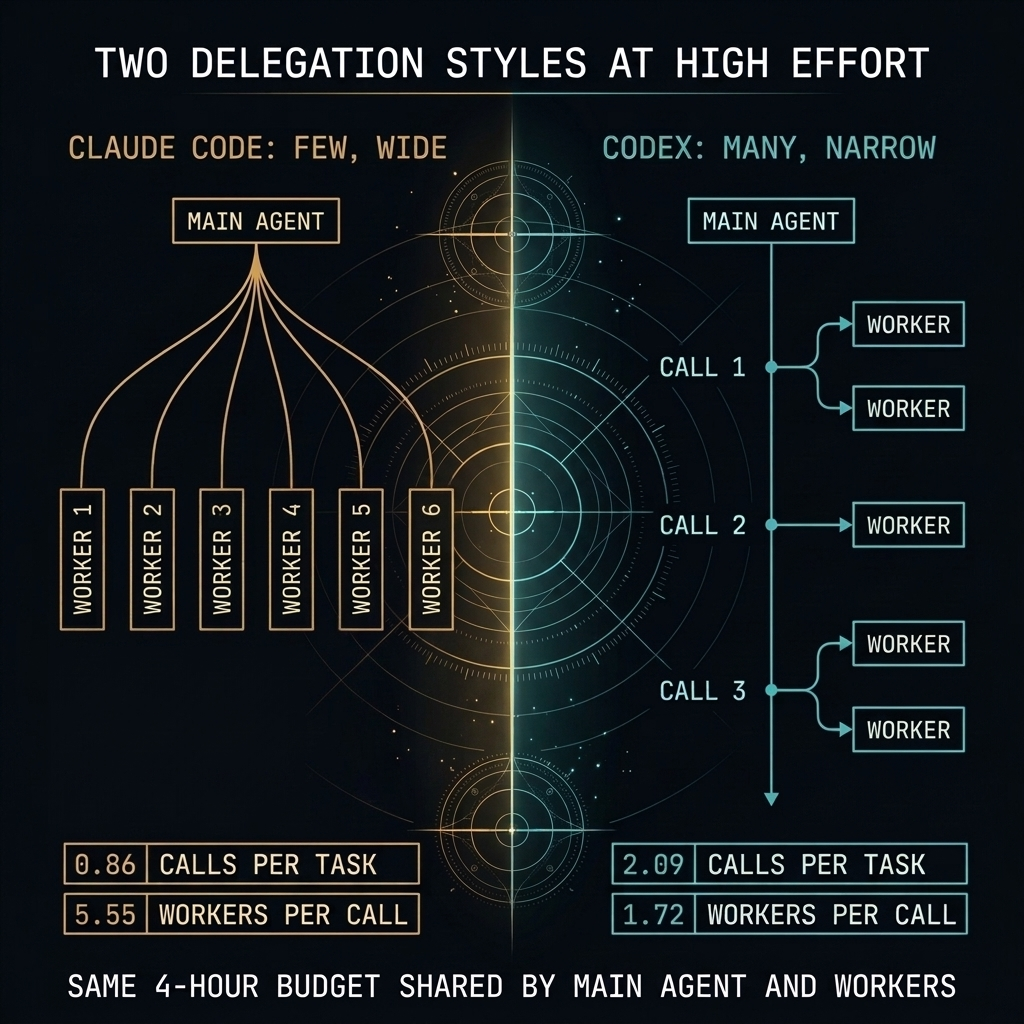
At high effort, Opus in Claude Code averages 0.86 Workflow calls per task with 5.55 workers per call. GPT-6 Astra in Codex averages 2.09 calls with 1.72 workers. About 99% of Astra and Sol Workflows have four workers or fewer, while 24-30% of the Claude models' Workflows have nine or more.
I would not read this as one style being correct. Each model runs in only one harness, so model and harness effects are mixed together. What the data does show is that call frequency by itself says little about how much collaboration is happening.
The experiment that matters: hold the executor fixed
System-level scores mix orchestration with execution. To separate them, the authors take a subset of 32 hard tasks and have a source model (Opus or Astra, at max effort) write the workflow. The source cannot edit the workspace. All work is done by workers that are instances of a weaker execution model: Kimi K3.1 Pro, GPT-6 Luna, Doubao-Seed-Evolving, or DeepSeek V4.1 Flash. In static mode the source writes a program once and it runs frozen. In dynamic mode the source watches results and revises the workflow as it goes.

One note on units: because resolved rates on 32 tasks move in coarse steps, this experiment reports continuous scores (0-100) on the 32-task subset, not resolved rates on the full benchmark. The two numbers are not comparable.
Compared with each executor running its own dynamic workflow, Opus-authored workflows raised the continuous score of all four executors: +6.41 points on average in static mode and +6.27 in dynamic mode. Kimi went from 35.75 to 46.61 under Opus dynamic workflows. Astra-authored workflows averaged -2.53 static and +1.34 dynamic, and lowered Kimi and DeepSeek in both modes.
This happened even though Astra is a much stronger solo system than any of the executors: on the full-benchmark resolved rate, Astra at max effort reaches 27.34%, against at most 16.48% for the executors. Being good at a task does not automatically make a model good at setting up that task for someone else. As the authors put it, the ability to orchestrate others "is not simply a byproduct of the ability to complete the task."
The authors flag a confound: the source writes the worker instructions, so some of the gain may be task knowledge passed through prompts rather than better structure. I don't see that as a flaw. Deciding what each worker needs to know is a core part of orchestration. But it means organization here includes context allocation, not just the shape of the graph.
What I take from it for harness design
Evaluate the planner and the workers separately. If the orchestrator role can be measured on its own, it can be chosen on its own. The transfer result points toward a strong, expensive orchestrator writing workflows for cheap executors. The paper names this as future work, and it is where I would look first for cost savings.
Make delegation observable. Production harnesses should route every delegation through one recorded interface, as WorkflowArena does. Without traces of who was asked to do what, with which context, you cannot tell bad decomposition apart from bad execution.
Make integration part of what you test. Many internal agent evals check components one at a time and miss the case where every part is right and the merged result is wrong. Add tests that only a reconciled deliverable can pass.
The usual caveats apply: one run per configuration and no variance estimates, LLM-judged scoring for content and 3D without a human agreement study, and only two source models in the transfer experiment. The central claim still holds up: how the work is organized is a measurable factor in performance, and it differs from how well a model does the work itself.
- 01WorkflowArena: Benchmarking Executable Workflow Orchestration in LLM-Based Multi-Agent Systems (arXiv:2611.12856)
- 02SWE-bench: Can Language Models Resolve Real-World GitHub Issues?
- 03WebArena: A Realistic Web Environment for Building Autonomous Agents
- 04MultiAgentBench: Evaluating the Collaboration and Competition of LLM agents
- 05Benchmarking Agentic Workflow Generation (WorFBench)
- 06OrchBench: Evaluating Multi-Agent Orchestration Plans in Isolation via Deterministic Simulation