QDA: when the quantization recipe becomes a search problem
QDA hands post-training quantization recipe design to an LLM agent, paired with a composable method library and a KL-divergence evaluator that scores a candidate in minutes rather than tens of GPU-hours. It beats the strongest public recipes by 0.9 to 2.2 points on reasoning models, and every checkpoint runs on existing serving kernels.
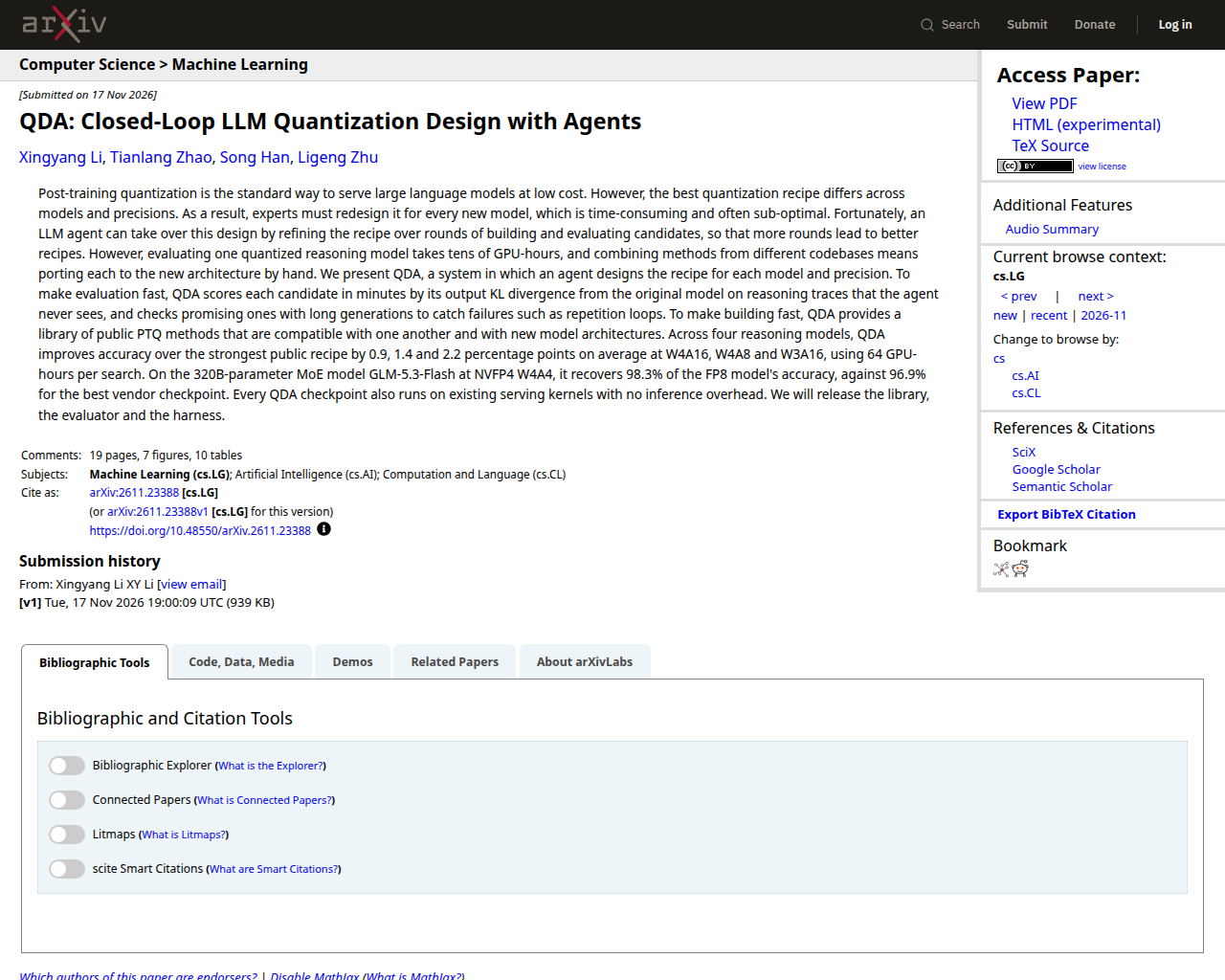
Anyone who has shipped a quantized model knows the awkward part. You don't pick a method. You pick a recipe: a transformation, a rounding scheme, how scales are chosen and tuned, and the calibration data. Then you find out that the recipe that worked on the last model doesn't carry over to this one. QDA: Closed-Loop LLM Quantization Design with Agents (Li, Zhao, Han and Zhu, MIT and NVIDIA) treats that as what it is, a per-model, per-precision search problem, and gives the search to an LLM agent.
The headline numbers: across four reasoning models, QDA beats the strongest public recipe by 0.9, 1.4 and 2.2 percentage points on average at W4A16, W4A8 and W3A16, with 64 GPU-hours per search (8 GH200 GPUs for 8 hours; the final benchmark evaluation is not charged to that budget). The checkpoints keep the standard formats and run on the existing vLLM kernels, so they add no inference overhead. I think the more useful lesson is in how they made the search affordable.
The recipe really does not transfer
The motivation section is worth reading even if you never use QDA. On Qwen3.5-9B, AWQ is 5.1 points more accurate than GPTQ at W4A16 and 12.3 points less accurate at W3A16. At W4A16 the best public recipe is ParoQuant on one model, AWQ on another and GPTQ on a third. Running GPTQ against the FP8 scales the W4A8 kernel actually stores raises Qwen3.5-9B by 5.3 points and lowers the other three models.
That matches my own experience in production. PTQ methods each fix a different source of error, so they stack. But methods that target the same error overlap, and you can't predict the best combination from the methods one at a time. The paper notes that NVIDIA's ModelOpt keeps a separate hand-written recipe for each of 28 models. That approach can't keep up with how often new open-weight models now ship.
Two bottlenecks, two pieces of infrastructure
An agent that searches by trial and error is only as good as how many trials it can afford. The authors name two costs.
Evaluation. A reasoning model writes tens of thousands of tokens per answer, and small benchmarks like AIME need many samples per problem. A full evaluation of one quantized checkpoint costs 23 to 86 GPU-hours. QDA replaces it with a proxy: the average per-token KL divergence between the candidate's and the original model's next-token distributions, measured on reasoning traces the original model wrote. The agent never sees those traces. The original model's side is cached once, so scoring a candidate runs only the quantized checkpoint, inside vLLM, on the same kernels that will serve it. That makes it 350 to 990 times cheaper than a full evaluation.
Two details here are careful work. First, storing full-vocabulary distributions would take hundreds of gigabytes, so the evaluator keeps the top 128 tokens per position plus one bucket for everything else. By the log-sum inequality this estimate can never exceed the true KL, and in practice it comes in 0 to 0.4% below. Second, the evaluator flags two candidates as tied when their KLs differ by less than the noise from rebuilding the same recipe on a different calibration subset (0.5 to 1.6%). That stops the agent from chasing chance differences, which is the most common way I have seen automated search go wrong.
Building. Most PTQ methods exist as research code tied to particular model families. QDA ships a library of 21 methods behind one interface, where each method takes a checkpoint in and returns one out, so methods compose in any order. Instead of hard-coded module names, the library works out from the model itself which layers feed which. Adding the 288-expert GLM-5.3-Flash took a 72-line adapter plus an extension for its FP8 release and multi-token-prediction layer. Batching the per-expert GPTQ solves brings one build of Qwen3.6-35B-A3B down from about 16 GPU-hours to 0.42.

Why KL, and where it falls short
The layer-wise reconstruction error that GPTQ and AWQ minimize only sees one layer at a time. On 44 checkpoint pairs, KL ranks 82% of them in the same order as accuracy, against 73% for layer-wise error. That is clearly better, but it isn't perfect. The authors handle the gap with a second signal: for a few promising candidates, the agent generates full answers to hard prompts it picks itself and counts loops and truncations.
This second signal earns its place. On Qwen3.6-35B-A3B at W4A16, calibrating on self-generated data cut KL by 30%. A long-generation check then showed the checkpoint truncating 12 of 191 answers, against 3 for the original model, mostly code answers stuck looping on debugging steps. The agent changed course and added scale distillation on the quantized model's own long answers. The final checkpoint beat the best public recipe by 1.3 points. The example shows why a generation check belongs in the loop: here KL improved while a failure mode that KL does not measure got worse.
What actually carries the gain
The ablations answer the question I care about most, which is how much of this is the agent.
- Given NVIDIA's ModelOpt and its recipe-search skill instead of QDA's library and evaluator, the same agent (Claude Code with Claude Opus 5.5) lands 0.5 to 1.3 points behind QDA, even though it selects on the test benchmarks.
- Swapping the agent for greedy search or ASHA over the same library comes within 0.1 points at W4A16 but falls 0.2 to 1.2 points behind at W4A8 and W3A16.
- Without the library and scheduler, the agent writes about three times as much code (3.1k against 1.1k lines), never tries a rotation, and loses twice as many GPU-hours to failed jobs.
My reading: in the easy regime, any reasonable search over a good library finds most of the gain. The agent pays off where the space is irregular, at lower precisions and with kernel-imposed constraints like FP8 scales, where it needs to diagnose problems rather than sweep hyperparameters. The logs show it doing that, for example tracing distillation loss spikes to scales crossing a rounding boundary together and then raising Adam's epsilon.
The result I would take to production
On the 320B-parameter MoE GLM-5.3-Flash at NVFP4, one search of about 6.5 hours on 16 GB300 GPUs (roughly 104 GPU-hours, plus $69 of agent tokens) recovers 98.3% of the FP8 model's accuracy, against 96.9% and 96.3% for the NVIDIA and Red Hat AI releases, and produces a smaller checkpoint. Because QDA keeps standard formats, the result is a drop-in replacement. ParoQuant needs an online rotation, and QDA decodes 1.30 to 1.75 times faster than it at W4A16.
The caveats are honest ones. QDA is 0.2 points behind GSQ on the MoE model at W3A16. The fixed recipe distilled from its searches (GPTQ on self-generated data, then scale distillation) is not an independent baseline. The library, evaluator and harness are promised but not yet released.
The pattern is what I'd take from this paper, even ahead of the specific numbers. If you want an agent to design something, spend most of your effort on a fast, hidden, low-noise evaluator with explicit tie-breaking, plus a composable action space. The agent then has a problem it can actually work on, and the KL proxy is what turns a 23-to-86-GPU-hour question into a few minutes of work.