GPT-5.6 Sol: a preview about tokens and control
OpenAI previewed the GPT-5.6 series — Sol, Terra, and Luna. The capability headline matters less than two shifts underneath it: intelligence is getting cheaper per token, and a frontier release is now gated by government review.

OpenAI opened a limited preview of the GPT-5.6 series on June 26, 2026 — three models under one banner: Sol, the flagship; Terra, the everyday workhorse; and Luna, the fast, cheap one. The headline writes itself: "our strongest model yet." I want to read past it, because the parts that change how I would actually deploy these are the ones the announcement buries — token efficiency, two new agentic modes, and a launch gated by the U.S. government.
What actually shipped
This is a preview, not general availability. OpenAI says the three models will be broadly available "in the coming weeks," and for now access is limited to a small group of trusted partners. The tiers are a familiar shape: Sol at the top with the deepest reasoning, Terra positioned to match GPT-5.5's performance at half the cost, and Luna as the lowest-cost option that still carries real capability.

The benchmark claims are specific, which I appreciate. Sol sets a new state of the art on Terminal-Bench 2.1, a test of command-line workflows that require planning, iteration, and tool coordination — the kind of long-horizon agentic loop that breaks weaker models. On GeneBench v1, a long-horizon genomics and quantitative-biology suite, Sol beats GPT-5.5 while using fewer tokens. On the cyber side, OpenAI reports that Sol is competitive with a model it calls Mythos Preview on ExploitBench while spending roughly a third of the output tokens.
The number I actually care about is tokens
In production, capability is table stakes; the bill is tokens. "Stronger than the last one" does not move my planning. "Competitive at one-third the output tokens" does, because output tokens are the dominant cost and the dominant source of latency in any agentic system that reasons before it acts.
That is the through-line across the whole release. Terra at half the price of GPT-5.5. Sol matching a frontier competitor at a third of the tokens. GeneBench results that improve while token usage drops. The interesting frontier here is not capability — it is capability per token. A model that reaches the same answer for a third of the spend changes which workloads are economical to run agentically at all. Tasks I would previously cap at a few reasoning steps, because the cost ran away from me, become viable when each step is three times cheaper.
Two new dials, and one of them is orchestration
GPT-5.6 adds two controls worth understanding. The first is a new max reasoning effort — Sol can simply think longer on a hard problem. The second is the one I find more interesting: ultra mode, which "goes beyond the capabilities of a single agent by leveraging subagents to accelerate complex work."
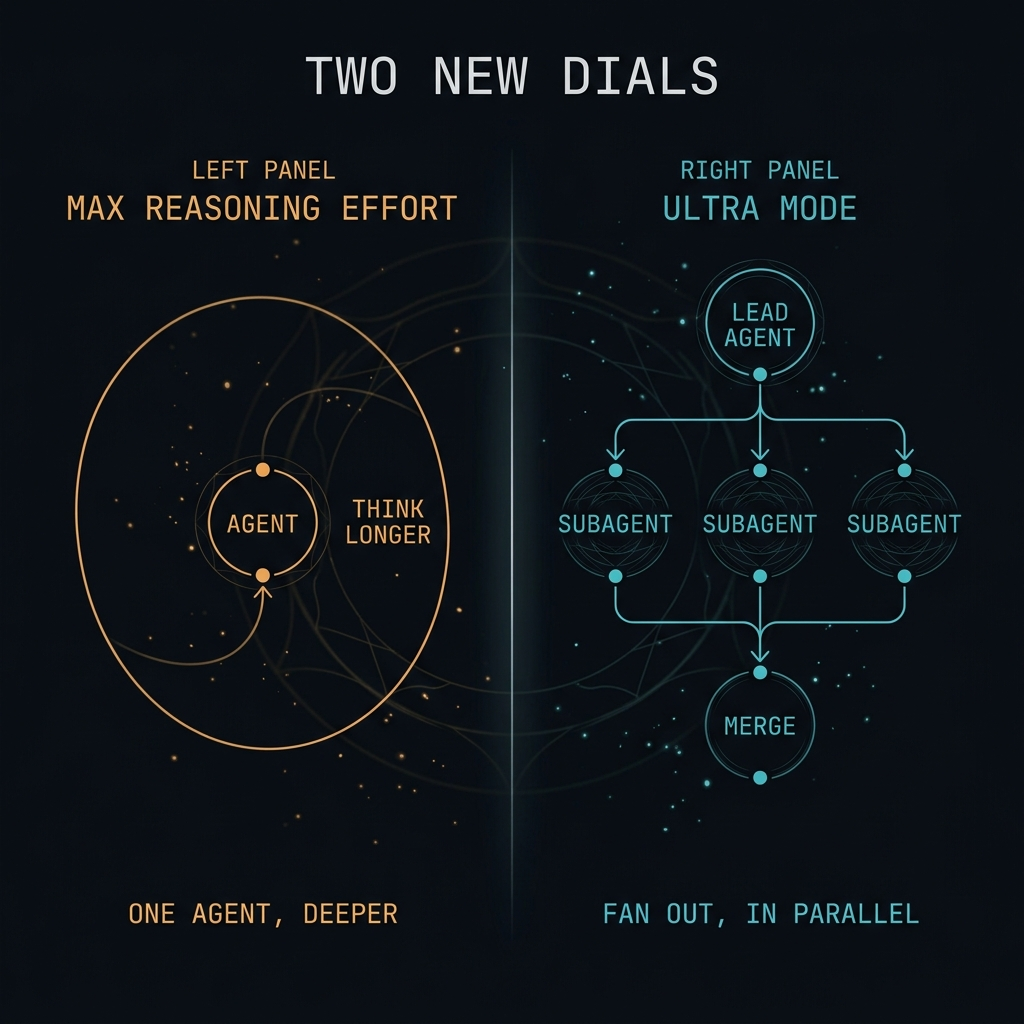
I read that as orchestration moving into the model layer. I already run multi-agent fan-out in production — a lead agent decomposing a task, subagents working independent pieces in parallel, results merged at the end. Seeing a lab ship that pattern as a first-class mode tells you where the abstraction boundary is heading. The trade-off is the one I manage by hand today: subagents buy breadth and wall-clock, but they multiply token spend, and you only come out ahead when the task genuinely decomposes. A model that decides when to fan out — and does it efficiently — is doing work I currently write in glue code. I will want to see how much control the API exposes before handing that judgment over.
Safety shipped as a surface, not a footnote
The release leads with safeguards, and the framing is right. OpenAI describes a layered safeguard stack, weeks of automated red-teaming, and strengthened protections for higher-risk activity and repeated misuse. What reads as credible is the stated goal: make prohibited offensive activity "more difficult, uncertain, and detectable" without choking off legitimate work — code review, vulnerability research, patch development, debugging, security education, defensive testing. That distinction is the hard part. A model that helps defenders also helps attackers; the honest response is to invest in friction and detection on the offensive side while keeping the defensive side open. Treating safety as a shipped surface, matched to each model's capability, is the correct posture even when it is imperfect.
The part that will outlast the benchmarks
The most consequential paragraph in the announcement is not about a benchmark. Because of the model's cyber capabilities, OpenAI previewed Sol's plans and capabilities to the U.S. government ahead of launch, and at the government's request is starting with a limited preview for partners whose participation was disclosed to the government — before any wider release. OpenAI is explicit that it does not want this to become the default, and says it is working with the Administration on a "cyber Executive Order framework" and a repeatable process for future releases.
Set aside how you feel about it; the structural fact is what matters. We have reached the point where a frontier model's release cadence is coupled to government review because of what it can do in security. That coupling will shape the next year of releases more than any single eval. For those of us building on these APIs, it means availability is now partly a policy variable, not only an engineering one — a dependency worth putting on the risk register.
My read
GPT-5.6 Sol is a capable model, but the preview is really about two things that do not fit on a benchmark chart: the cost of intelligence is dropping fast enough to change what is worth automating, and the governance of frontier capability is moving upstream into the release itself. I will judge the models when they are generally available and I can run my own evals. Until then, the efficiency numbers are the ones I would plan around.