PhysLoop: a simulator-backed harness for physically grounded video data
PhysLoop has an LLM write simulator scenes, verifies the physics twice, and uses the results to generate and repair videos, releasing 100K training videos and two eval sets. The harness and data are useful, but the recursive self-improvement loop is not yet closed.
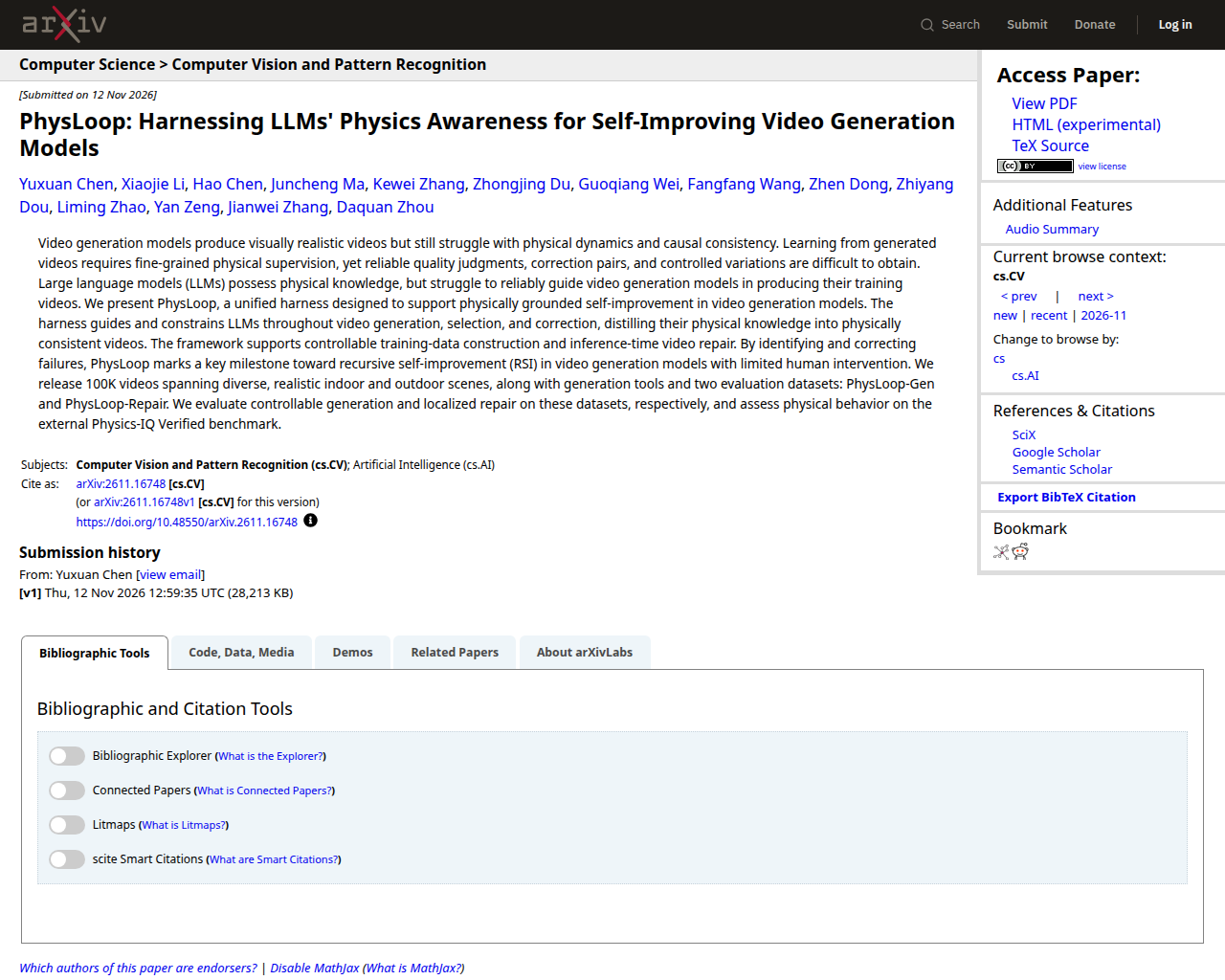
Video generation models have reached the point where a single frame often looks right while the sequence is wrong. A glass falls and doesn't break, a billiard break gains an extra cue ball, a domino chain stops one tile short of the vase it was supposed to knock over. PhysLoop, a new paper from Peking University, ByteDance Seed and collaborators, goes after this with a familiar move from agentic systems: don't trust the generator, put an executable environment and a verifier around it.
The paper frames this as a step toward recursive self-improvement (RSI) for video models. I think the harness and the data are useful. I'd treat the RSI framing as a direction the authors want to go, not something the paper shows.
The core idea: LLM knowledge, constrained by a simulator
The premise is one I agree with from my physics training. LLMs carry a lot of physical knowledge, but they apply it inconsistently. Asking a model to imagine a falling glass gets you something plausible. Asking it to write a scene program that a physics solver then executes gets you something you can check. PhysLoop puts the LLM in the role of scene author and leaves the dynamics to the solver.

The pipeline, as described in the full paper:
- Task specification. A code agent turns a request into a spec that records the target event, the assumptions it had to invent (release height, impact surface), and the conditions verification will check.
- Scene construction. It retrieves or generates assets, pairs detailed render meshes with separate collision proxies, writes a scene program, and renders low-resolution preview frames to catch occlusion and misplacement before paying for a full run.
- Physics execution. Unreal Engine is the main simulator, with Taichi and Genesis behind adapters. Every frame is tied to a simulation time and captured alongside depth, instance segmentation and object states.
- Simulation verification. Machine-checkable assertions over the simulation record: contact existence and order, thresholds on displacement, trajectory integrity, plus a technical gate (codec, frame count, unintended initial contacts, depth error under 1 cm on average).
- Appearance refinement. A video model (Seedance 2.5 by default) uses the verified render as a motion reference and restyles it toward the requested look.
- Final-video verification. The same task conditions get checked again, because refinement can undo motion that passed in simulation.
When a check fails, the verifier returns evidence and the agent revises the stage that caused it. The task objective and the criteria stay fixed. I'd point to that detail as the most important design choice in the paper. An agent that can relax its own success criteria will end up gaming them.
Repair as a first-class task
The second application is the one I find most practical. Given an existing generated video with a physical error, the agent locates the faulty interval [a, b), rebuilds just that event in simulation, refines it to match the source's appearance, and splices it back in, leaving every frame outside the interval unchanged. The paper notes that this local replacement may not be enough when the error has already changed later events.
The repair numbers are the paper's strongest result. On PhysLoop-Repair (50 tasks), the full configuration succeeds on 86% of tasks, against 19.33% for the best standalone generator. All three standalone generators stay under 20%. That gap makes sense. Repair needs you to fix the error, keep the surrounding content and match the boundaries, all at once, and prompting a generator to "fix this" gives you no handle on any of those three.
What the numbers do and don't show
The abstract carries no quantitative evidence. The full text does, and it is worth reading carefully.
On PhysLoop-Gen (100 tasks), task success is 85% for PhysLoop versus 73% for standalone Seedance 2.5. Human ratings rise for physical plausibility (4.06 vs 3.80) and causal consistency (4.12 vs 3.80), but visual realism drops (3.72 vs 4.29), mostly in materials and backgrounds. Automatic metrics from VideoPhy and VBench are mixed and slightly lower overall. The authors argue those metrics struggle with temporal physics errors. That may be true, but it is also the argument you'd make either way.
The ablations are informative:
- No refiner already reaches 80% generation success. Most of the task completion comes from scene construction plus simulation, and the refiner mainly buys appearance (realism goes from 2.59 to 3.72).
- Refiner choice dominates some metrics. With the same agent backbone, swapping Seedance 2.5 for Gemini Omni drops Physics-IQ Verified from 52.06 to 12.08. The final verifier is doing real work, and the refiner is a real source of error.
- Rankings disagree across benchmarks. Claude Opus 5 as the backbone gets the best Physics-IQ Verified score (53.75) but lower task success. Completing the requested event and matching a recorded physical continuation are different targets.
A few caveats I'd flag before relying on these numbers. The pairwise "Win" column comes from 301 unblinded comparisons by one author. The main human ratings are blinded and multi-rater, so I'd lean on those and ignore the win rate. The benchmarks are small (100 and 50 tasks), the authors built them, and they were designed around the kinds of events a simulator handles well.
The RSI claim
What the paper does not contain is a model trained on PhysLoop-100K and shown to improve. The 100K videos (2.5K distinct events, about 40 variants each, 3–5 views, systematic parameter grids over friction, release angle, Young's modulus and so on) are released as training data, but I found no fine-tuning experiment in the text. The limitations section says so plainly: closing the loop requires weakness discovery, candidate generation, verification, data selection and model updates across rounds, and "future work must establish whether this process yields sustained gains on held-out events."
So the accurate description is a quality-control component for a self-improvement loop, which is how the conclusion itself phrases it. That is valuable, since verification is the part most self-training loops get wrong. Still, the dashed arrow in the diagram above is the paper's open question.
The ceiling is also structural. PhysLoop can only certify physics its simulators can represent and its assertions can express. A video model trained on it learns rigid bodies, cloth, simple fluids and fracture as Unreal and Taichi render them. I would expect it to inherit both the strengths and the blind spots of those solvers.
What I'd take from it
If you build video generation systems, three things here are worth adopting now:
- Verify twice. Check physics in the simulator, then check again after any generative refinement step. The refiner ablations show why.
- Freeze the objective during revision. Let the agent change the scene, never the success criteria.
- Treat repair as interval replacement with hard boundaries. It is easier to verify than regeneration and more useful in a real editing workflow.
The dataset, both eval sets and the tooling are public via the project page and GitHub repo. I'd use them for physically controlled fine-tuning data and as a repair benchmark. For the recursive self-improvement claim, I'm waiting on the experiment that actually trains a model on this data.