Teaching a model to read the textbook: RL for self-learning from long references
A new paper trains a 35B model with RL to study math textbooks through a navigation tool while proving exercises, lifting proof accuracy from 51.5% to 79.5%. The headline is real, but the most useful result is how outcome-only RL quietly teaches a model to stop reading, and how small the transfer to general long-context benchmarks remains.
Most of what we call "retrieval" in production LLM systems is really lookup. A query goes in, a few chunks come back, the model summarizes them. That works when the answer is sitting in a document. It does much less when the model has to learn something, like a definition or a theorem, and then use it in a derivation the source never spells out.
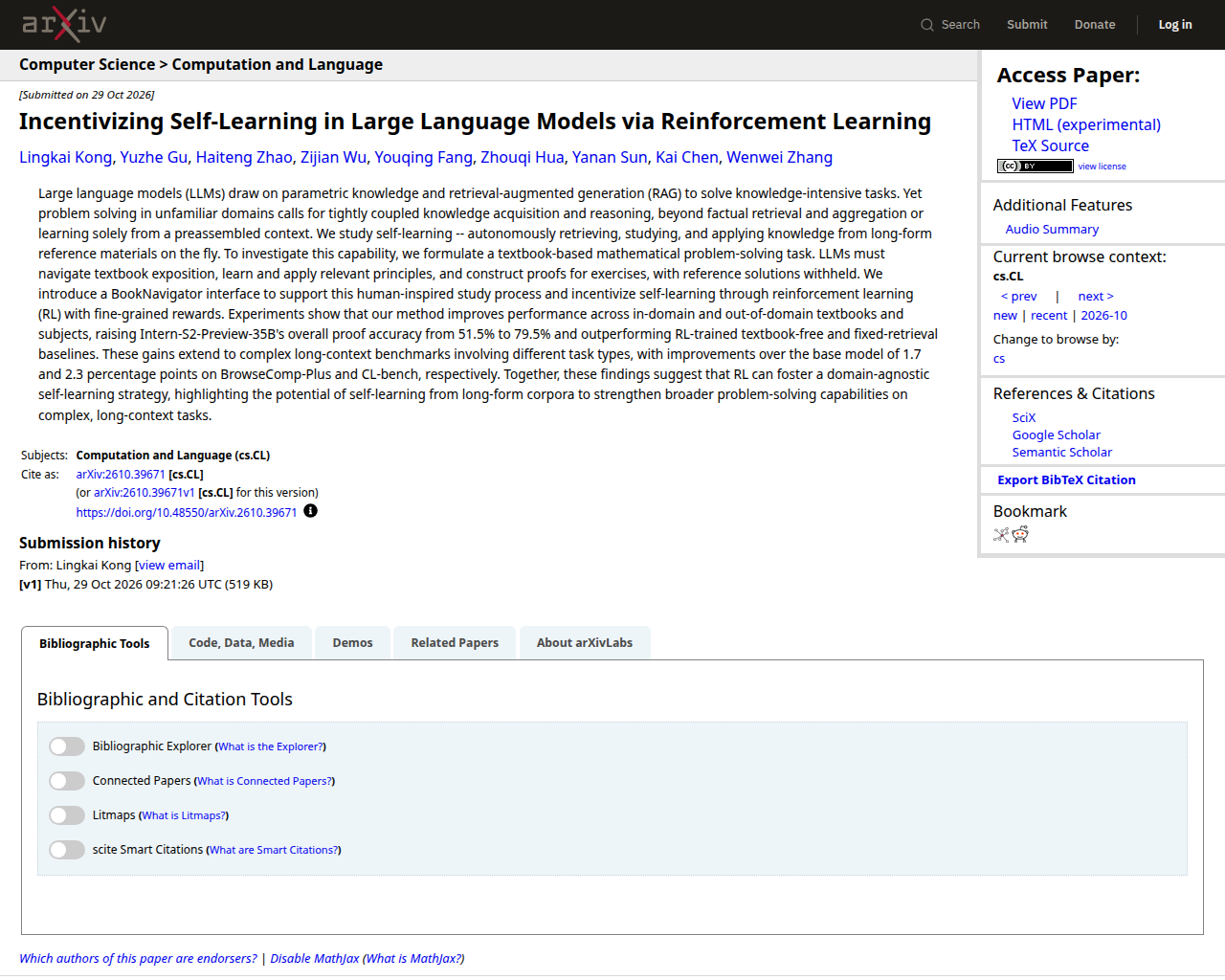
That gap is what Incentivizing Self-Learning in Large Language Models via Reinforcement Learning (Kong, Gu, Zhao et al., Shanghai AI Laboratory) tries to train for. The authors call it self-learning: retrieving, studying, and applying knowledge from long-form reference material while the task is in progress. The testbed is a good choice. You hand the model an advanced mathematics textbook with the exercise solutions removed, give it an exercise, and ask for a proof.
The headline number is real: Intern-S2-Preview-35B goes from 51.5% to 79.5% overall proof accuracy. But the most useful finding, in my view, is in the ablation table, and it concerns what RL does to a model's willingness to read.
The setup
The authors parse 158 undergraduate and graduate textbooks into chapter-indexed sections, about 56 sections and 208k tokens per book on average, and drop any exercise that references a section number. That leaves 5,183 proof problems; training uses 4,557 of them from 132 books. Evaluation covers held-out problems from training books, seven unseen books in familiar subjects, and 19 unseen probability and statistics books.
The model reaches the book through one interface, BookNavigator, with three actions: get_toc for the table of contents, search_index for keyword search over ranked snippets, and read_section for the full text of one section. It gets at most eight rounds and 64k tokens, and can alternate reasoning and reading however it likes.

GLM-5.2 judges the final proof against the withheld solution under 8-shot pessimistic verification, so a proof counts as correct only if all eight independent reviews accept it. That is a strict bar, and I think it is the right one for proofs, where a lenient judge gets exploited quickly. On top of the outcome signal, the authors make two changes to GRPO:
- Annealed exploration bonus. A correct trajectory with at least one successful tool call gets extra reward, scaled by a cosine schedule from 1.0 down to 0.25 over 50 rollout steps.
- Round-level tool credit. A frozen copy of the initial model labels each tool round useful, neutral, or harmful, seeing only the interaction and the next round of reasoning, never the reference solution or the verdict. The trajectory advantage is redistributed across rounds and centered so the token-weighted mean stays unchanged.
Before RL, the book hurts
Before training, giving the model the textbook through BookNavigator makes it worse: 51.5% against 55.7% with no book at all. The untrained model does not yet know how to use the reference.
After RL the order reverses. Self-learning reaches 79.5% overall, ahead of no-book RL (68.5%) and the best fixed-retrieval baseline, top-k sections stuffed into the prompt (73.1%). The lead holds on unseen books (85.2% vs 81.0%) and unseen subjects (86.7% vs 81.3%). One caveat on that comparison: the baselines were trained with correctness-only GRPO, while the self-learning policy also got the exploration bonus and tool credit. The 6.4-point gap mixes the protocol with the reward design. The closest like-for-like number is in the ablation: self-learning trained with correctness-only GRPO reaches 74.9%, 1.8 points above top-k.
The attribution experiments help here. The RL-trained policy with no book scores 71.7%, a 16-point gain in unaided reasoning that accounts for a large part of the improvement. With the paired textbook it is still 7.8 points higher. Given a different book on the same topic, it scores 75.2%. Deleting the source section and its eight neighbors drops accuracy to 74.6%, while deleting nine random sections leaves it at 79.8%. The model depends on specific content and partly recovers when that content is missing.
Correctness-only RL teaches the model to stop reading
This is the result I'd want every team building agentic RL to see.

With correctness-only GRPO, accuracy rises from 51.5% to 74.9%, while the share of trajectories that touch the book drops from 36.9% to 6.7%, and calls per trajectory fall from 1.5 to 0.3. The authors offer a plausible explanation rather than an established mechanism: as unaided problem solving improves, the policy can solve more problems without references, so its incentive to consult them shrinks. Whatever the cause, it is the wrong habit for problems that need knowledge the model doesn't have.
Tool credit alone doesn't fix this: tool use stays at 7.0%. The exploration bonus pushes it to 79.9%, and that is where the out-of-domain gains appear. The full method settles at 58.4% tool use and 3.0 calls per trajectory, less reading than the bonus-only variant and higher accuracy on every split. The goal was never to maximize tool calls. It was to keep reading available as a behavior while credit assignment trims the wasted calls. The practical lesson is that aggregate reward can rise while a behavior you care about disappears, so tool-use rates belong next to accuracy in RL logs.
Where I'd temper the claims
The 79.5% is on a task the authors built, scored by an LLM judge. The judge is strict, but it is still a judge.
The transfer evidence is much thinner. On BrowseComp-Plus the trained policy gains 1.7 points (50.2 to 51.9), and on CL-bench it gains 2.3 (14.8 to 17.1). Both are the best among the variants tested, and the fixed-retrieval RL policies mostly regress on BrowseComp-Plus. But these are small gains on one model, and every RL variant does worse than base on CL-bench's procedural-execution category. Calling this a "domain-agnostic self-learning strategy" goes further than two benchmarks can support.
The tool judge is the initial model, frozen. The authors present this as a strength, and the 3.3-point in-domain gain from tool credit supports that. I'd still like to see whether a stronger judge helps more, and whether the "harmful" label (mapped to 0.5 against 1.0) does much beyond penalizing repeated calls.
What to take from it
- Giving a model a tool doesn't mean it can use the tool. Untrained, the book reduced accuracy.
- Outcome-only RL can optimize away behaviors you care about. Monitor tool use during training, not only reward.
- The full self-learning recipe beat RL-trained top-k retrieval by 6.4 points, but with a richer reward than the baseline received. Under the same correctness-only reward the margin was 1.8 points. Agentic retrieval looks worth training for; how much of the gain comes from the reading itself versus the reward shaping is still open.
Textbooks are a good environment for this kind of study: structured and long, with clean separation between exposition and exercises. Whether the recipe works on messier corpora like internal wikis, codebases, or regulatory documents is the next question, and I suspect the exploration-collapse problem would be harder there, not easier.