Google's planetary prediction engine turns geospatial modeling into an agent's job
Google Research's planetary prediction engine (PPE) autonomously runs the full geospatial modeling workflow — data discovery through model training — and beats manual expert pipelines on health, food security, and outbreak forecasting benchmarks. Here's what the architecture gets right, and what I'd still want to see before I trust it in production.

Google Research introduced the planetary prediction engine (PPE) this week, an experimental system under the Earth AI umbrella that takes a natural-language query — forecast food insecurity in a region, nowcast disease spread, map socioeconomic vulnerability — and autonomously runs the entire geospatial modeling workflow: find the data, engineer the features, train the model, evaluate it, write the report. No specialized team spending weeks on manual curation. I spend my days building agentic systems that have to actually work in production, not just in a benchmark table, so I want to walk through what's structurally interesting here and where I'd push back before calling this solved.
The problem PPE is aimed at
Geospatial prediction — the kind that feeds humanitarian response, public health surveillance, disaster risk models — has a data problem that's different from typical ML. The signal you need is scattered across satellite imagery, census data, climate records, and ad hoc government portals, all at different spatial resolutions and temporal cadences. Standard AutoML tools assume you've already solved that: they start from a clean tabular dataset. LLM agents that automate ML pipelines make the same assumption. The actual bottleneck in planetary-scale analytics has never been model selection — it's the weeks of manual joining, cleaning, and validating that happen before a model ever sees the data. That's the gap PPE is targeting, and it's the right gap to target. When a disease outbreak is accelerating, a four-week data engineering cycle is the whole problem.
How it's built: three stages, opaque handles between them
PPE decomposes the workflow into three LLM-orchestrated stages, and the design choice I find most telling is what passes between them.
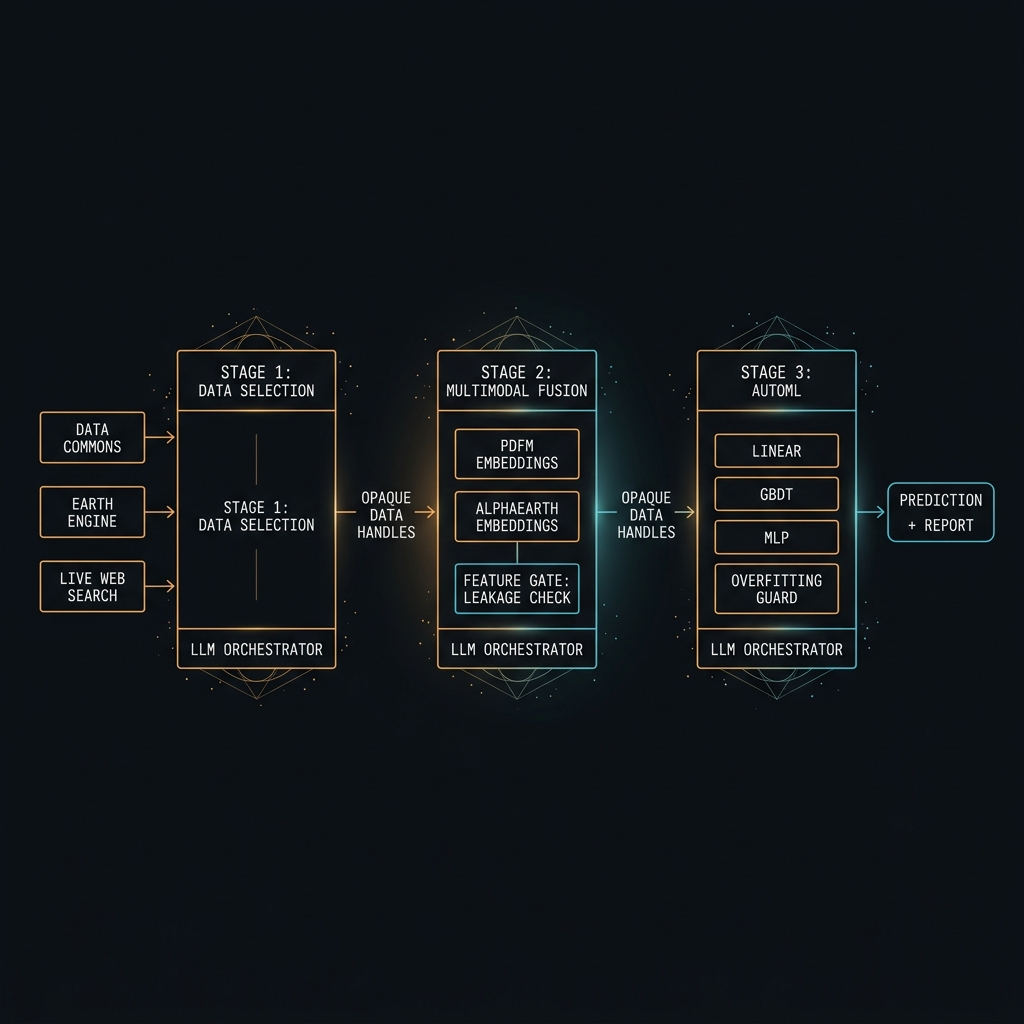
Stage 1, intelligent data selection, turns the query into geographic constraints — spatial granularity, join keys, temporal scope — then does what the team calls grounded signal discovery: forming domain hypotheses, pulling direct and causal proxy signals from Data Commons and Google Earth Engine, and falling back to live web search across government and academic portals when a signal isn't in an established repository.
Stage 2, multimodal dataset curation, fuses those statistical covariates with two pretrained geospatial foundation models — Population Dynamics Foundation Models (PDFM) for socio-demographic latent state and AlphaEarth for satellite imagery semantics. This is where I'd flag the most operationally serious piece of engineering in the whole system: the Feature Gate, which screens every candidate covariate against four leakage criteria — filtering out mathematical sub-components of the target, shared survey provenance, downstream causal effects, and features that are temporally in the future relative to the prediction window. Automated leakage detection is a problem most teams solve badly or not at all, because it requires reasoning about causal structure, not just correlation, and getting it wrong silently inflates every benchmark number downstream.
Stage 3, automated model building, searches regularized linear models, gradient-boosted trees, and MLPs, gated by what they call an Overfitting Guard Protocol — a self-correction loop that pre-assesses dataset risk and detects generalization failure during search rather than after.
The architectural detail worth stealing regardless of domain: data artifacts move between stages as opaque handles, not as text serialized into the next stage's prompt. Anyone who has tried to chain LLM agents on real datasets has hit the failure mode where stage N's output degrades because it got flattened into a context window stage N+1 has to re-parse. Passing handles instead of payloads keeps each stage's context bounded and avoids compounding transcription errors across a long pipeline. This is standard practice in workflow orchestration systems; seeing it applied to keep LLM orchestrators honest is the right instinct.
What the benchmarks show
The reported numbers are a real gap, not a rounding error. Across 21 CDC health indicators, PPE hits a mean R² of 76.8% versus 60.0% for a manual expert pipeline. On FEMA national risk indicators it's 64.9% versus a 60.0% baseline, and on the Social Vulnerability Index, 66.2% versus 58.6%. In Nigeria, downscaling food security estimates from provincial (ADM1) to local government area (ADM2) resolution — the level humanitarian responders actually need — PPE roughly doubles baseline accuracy, R² of 66.1% versus 31.5%, by autonomously pulling in market shocks, price anomalies, and microclimate indicators that a manual pipeline likely wouldn't have prioritized. For nowcasting new transmission hotspots during the 2026 Bundibugyo ebolavirus outbreak in the DRC, PPE reached Recall@10 of 83.3% — correctly flagging 15 of 18 newly invaded health zones across five weekly forecasts — a 10.3-point improvement over the published Bayesian state-of-the-art baseline of roughly 73%.
The team's ablations point to the fusion being additive, not redundant: structured statistical covariates and the foundation-model embeddings each carry signal the other doesn't, and combining them with the intelligent data-selection step outperforms either approach alone.
What I'd want to see next
This is explicitly an early-stage research capability, not a product, and the honest framing matters. A few things I'd watch for before treating this as a template:
First, all the benchmarks compare PPE to a manual expert pipeline baseline. That's the right comparison for measuring automation value, but it doesn't tell you how PPE performs against a well-tuned, non-agentic AutoML system running on the same fused feature set — a comparison that would isolate how much of the gain comes from data selection versus modeling.
Second, "Recall@10 of 83.3% across five sequential weekly forecasts" during a live outbreak is an evaluation on one outbreak trajectory. Epidemic dynamics are noisy and outbreak-specific; I'd want to see this repeated across multiple outbreaks before reading too much into a single-digit sample of health zones.
Third — and this is the part I care about most from a systems-design angle — nothing in the writeup addresses failure containment. What happens when the live web-discovery step in Stage 1 pulls a low-quality or adversarial source? What's the fallback when the Overfitting Guard's self-correction loop can't converge? An autonomous system feeding humanitarian decision-making needs a documented answer to "how does this fail gracefully," not just "how does it perform when it works."
None of that undercuts the core contribution. Turning weeks of data engineering into minutes, for problems where minutes matter, is a genuinely useful direction — and the modular, handle-passing architecture is a pattern worth borrowing well outside geospatial ML. I'll be watching for the paper and any follow-up on failure modes.