Grounding lab agents in physical state, not just good reasoning
Google Research's new work on autonomous wet labs argues that the bottleneck for scientific agents is no longer ideation but grounded execution and fast experimental feedback. A stateful digital twin of the lab, plus closed design-test loops, is what lets an agent correct its own mistakes.
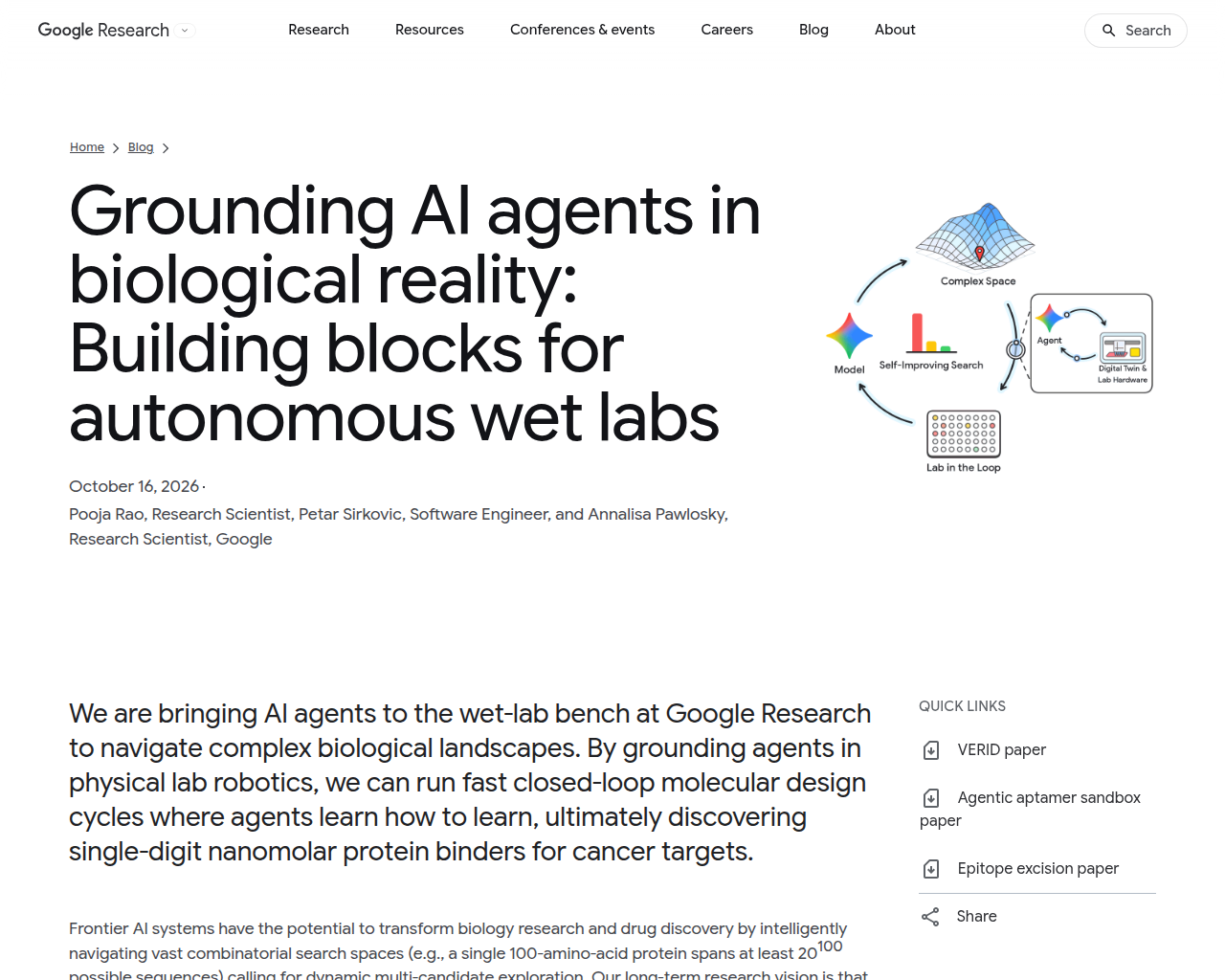
Most of the agent work I see in production fails the same way: the model produces a plan that is syntactically valid and practically wrong, because it has no reliable picture of the state of the world it is acting on. A new post from Google Research, Grounding AI agents in biological reality: building blocks for autonomous wet labs by Pooja Rao, Petar Sirkovic and Annalisa Pawlosky, takes that failure mode into the hardest setting I can think of: a physical lab bench, where a wrong command spills reagent, crashes a pipette, or quietly corrupts an experiment.
The post covers three projects. I want to walk through them less as biology results and more as a design pattern for any agent that acts on the physical world.
The two problems the post names
The authors frame the challenge plainly. First, frontier models still do not reason reliably about 3D geometry and physical state, which matters a lot when the agent is driving a liquid-handling robot that moves reagents, tracks volumes, and runs protocols. Second, in-silico hypothesis generation has accelerated faster than wet-lab experimentation, so experimental readouts are now more of a bottleneck than ever.
The scale argument is familiar to anyone from physics: a single 100-amino-acid protein spans at least 20^100 possible sequences. You do not search that space by thinking harder. You search it by running many cheap, well-instrumented experiments and letting the measurements correct you.
VERID: a digital twin as the agent's ground truth
The first project, VERID (VERified Infrastructure for Discovery Laboratories), is the one I would study most closely if I were building agents for any hardware. It is a semantic digital twin of the lab workcell: a live, stateful 3D volumetric entity tree that tracks robotic arm geometry, individual well volumes, reagent identities, and pipette tip inventory. It is built on the open-source PyLabRobot framework.
The key observation in the post is that the safety of a command depends on the live physical context as well as the code. An agent can write code that is physically impossible (lowering an 8-channel pipette into a trough that is too short), logistically invalid (aspirating from a depleted well), or scientifically compromised by fluidic effects the model never considered. None of these are caught by a type checker or a code review.
VERID provides four capabilities: live 3D state the agent can query before acting, virtual dry runs that simulate a protocol in seconds, hardware safety checks that block invalid commands before they reach the robot, and synchronized video and action logs for every run.

The case studies are what make this convincing. When the simulator rejected an 8-channel aspiration that would not physically fit, the agent replanned and designed a targeted factorial diagnostic that isolated a subtle bias from residual tip-wall carryover, which replication alone would have missed. Synchronized video caught uneven dye stratification from dispensing too close to the well floor. The persistent twin let the agent recover mid-run from a plate-reader failure without re-pipetting. And in a closed-loop self-play campaign reconstructing blinded dye mixtures from overhead camera images, the agent identified its own optical and fluidic artifacts and improved accuracy more than fivefold.
The pattern generalizes. The model is not made safer by being smarter; it is made safer by being forced to check its plan against an authoritative state model before anything irreversible happens. That is the same reason I put explicit state stores and dry-run modes in front of agents that touch money, infrastructure, or customer data.
Aptamers: when the readout corrects the agent
The second project, Aptamers as a sandbox for lab-in-the-loop agentic molecular discovery (linked from the post), uses protein-binding DNA aptamers as a fast loop. DNA can be synthesized in pooled libraries and read out by sequencing, so one design-test-analyze cycle takes 7 to 10 days. Agents ran three rounds against two targets, myoglobin and α-thrombin.
The headline numbers are confirmed on-target hit rates of 33.5% for myoglobin and 42.1% for α-thrombin. The more instructive part is how each target failed first. On α-thrombin, Round 1 yielded zero binders because fixed primer overhangs disrupted folding in 48% of sequences. The agents introduced clamped flanking stems in Round 2 and diversified in Round 3, reaching 26.0% and then 42.1% at 98.5% specificity.
Myoglobin is the case I find most useful as a lesson about reward hacking in the physical world.

In Round 2 the agents optimized for raw binding and heavily enriched G-quadruplex motifs, 63% of designs. Raw pull-down went up. But the wet-lab data showed these were mostly non-specific sticky binders adhering to off-target proteins and bare magnetic beads. Specificity fell from 75.0% to 19.1% and the bead-corrected hit rate fell from 10.2% to 3.7%. Reading that readout, the agents revised their own design rules for Round 3: cap promiscuous motifs, subtract bead binders, pivot to non-G4 scaffolds. Specificity recovered to 72.4% and the on-target hit rate rose ninefold to 33.5%.
This is the clearest illustration I have seen of why the measurement has to be in the loop. An agent optimizing a proxy will find the proxy's loophole. Only a readout that separates the real signal from the artifact (here, the bead-only control) lets it notice and recover.
Proteins: a slower loop, a harder target
The third project, Agent-guided epitope excision enables economical de novo binder design, applies the workflow to fibroblast activation protein alpha (FAP), a large receptor overexpressed in solid tumors. Proteins are harder to close the loop on than aptamers: they must be expressed biologically, adding selection, expression and folding steps, and the sequence space is larger. The post reports that surgical epitope excision accelerates structure prediction 8.6x, and that within a few experimental runs the top designs reached single-digit nanomolar affinity, a level usually reached only after extensive rounds of lab optimization.
What I take from it
Three things, and none of them is specific to biology.
- State before action. An agent acting on the physical world needs an authoritative, queryable model of current state and a cheap dry run. Reasoning quality does not substitute for it.
- Instrument everything. Synchronized logs and video turned silent failures into diagnosable ones. Traces are what let an agent, or a human, separate signal from procedural noise.
- Fast loops beat clever priors. The aptamer results came from three rounds, with the agent's mistakes surfaced and corrected by data. The cycle time of the experiment, not the model, sets the pace of discovery.
The authors are explicit that this is meant to be driven by human scientific agency, and I think that is the right posture. What they have built is less an autonomous scientist than a well-grounded apprentice: one that cannot ignore the state of the bench, and cannot ignore what the measurement says.