What 18 million hours of accelerometer data taught researchers about wearable motion models
Inertia-1, an open study from UCLA, Duke, and Johns Hopkins, pretrains on 18.2M hours of accelerometry from 115,000+ people to isolate which design choices actually make wearable motion foundation models transfer — and finds that data pipeline decisions and data scale matter more than model size.

A team out of UCLA, Duke, and Johns Hopkins just open-sourced Inertia-1, the most systematic study I've seen of what actually makes a wearable motion foundation model transfer. The repo ships code, configs, and a full paper; I read through both because the question it asks is one I run into constantly outside of wearables too: when you're building a foundation model, which design axis is actually load-bearing, and which is just folklore?
Motion sensing has been a mess of one-off models for years. Every lab picks its own sampling rate, window length, sensor placement, and axis representation, then trains a bespoke model for a bespoke task. Inertia-1's contribution isn't a new architecture — it's a controlled experiment across the full lifecycle (data, sensing, objective, scale) on a genuinely large corpus: 18.2M hours of raw accelerometry from more than 115,000 people across 15 datasets, evaluating 10 pretraining objectives and over 1,000 trained models against three task families — human activity recognition (HAR), freezing-of-gait detection (FoG), and disease prediction.
Pretraining helps, but the gain is not evenly distributed
The first result is unsurprising on its face: self-supervised pretraining beats supervised training from scratch across every task family. What's more interesting is how much that gain depends on where the task sits on the spectrum from generic to clinical.
The paper reports two numbers per task family: SSL variance (the gap between the best and median self-supervised objective) and SSL gain (the gap between the best self-supervised model and the best supervised baseline). For HAR, both are small — 2.5 and 4.0 AUROC points. For FoG detection they jump to 11.0 and 16.4. For disease prediction they climb further, to 10.0 and 19.7.
<br>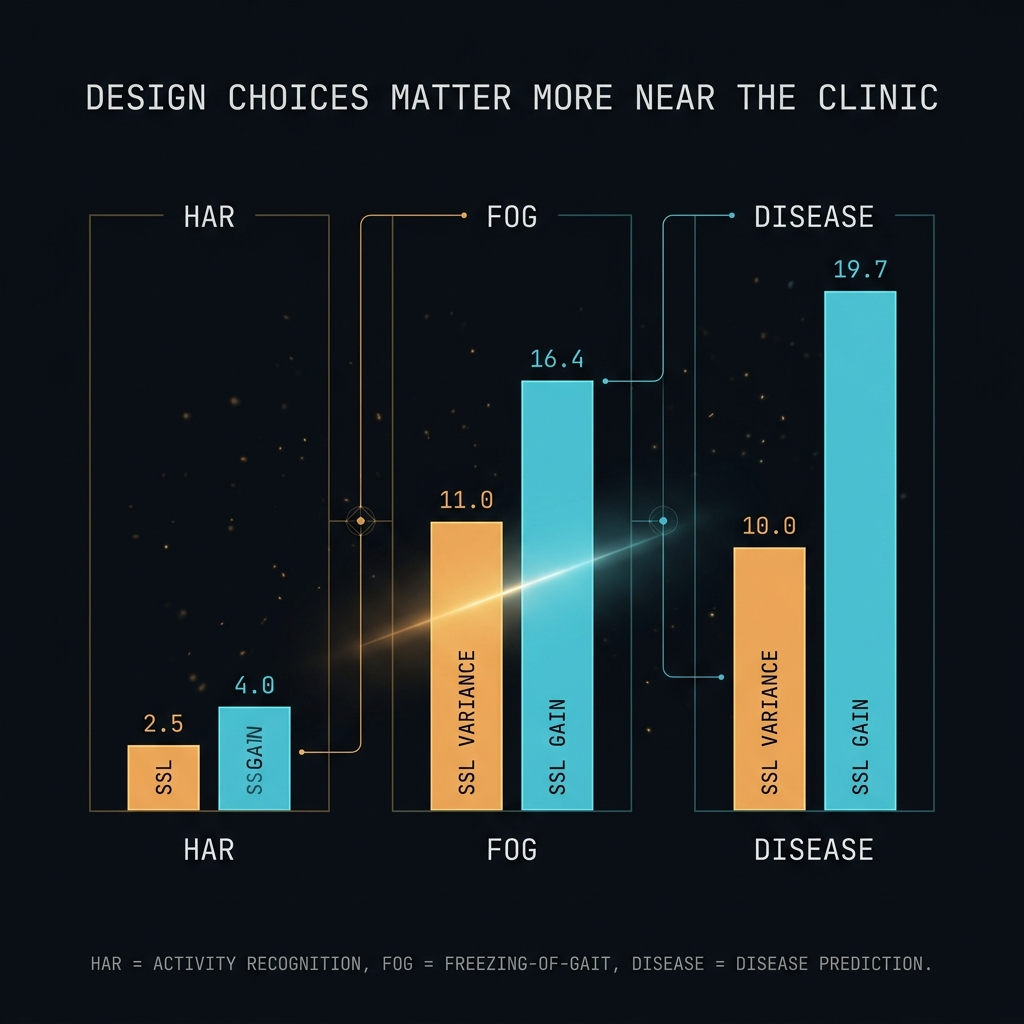
Read plainly: basic activity recognition is close to saturated — walking versus sitting is an easy signal to extract almost regardless of pretraining recipe. But the closer a task gets to a clinical outcome, the more the specific choice of objective, and the decision to pretrain at all, determines whether the model works. That's a useful prior for anyone scoping a wearable ML project: don't assume the modeling choices that worked for your activity classifier will carry over once you move to a health outcome.
The sensing pipeline is not a footnote
The paper's control studies on sampling rate, window length, axis count, and representation domain are the part I'd flag to anyone shipping a real device pipeline, because the answers are not what conventional wisdom (or prior smaller studies) would predict.
Downsampling to 1Hz costs less than expected for HAR — pretrained representations stay competitive even when high-frequency detail is gone, because large-scale pretraining seems to capture contextual motion patterns that partially compensate for the lost resolution. Disease prediction doesn't get the same free pass: it degrades more with lower sampling rates, which tracks with the intuition that subtle biomechanical signatures are exactly the high-frequency content that aggressive downsampling throws away. Window length shows no universal optimum — 30s and 60s both perform well overall, but which one wins depends on task granularity, not on some fixed "right" window. Triaxial input beats vector-magnitude summaries across every task family, meaning the common privacy-motivated practice of collapsing three axes into one loses transferable structure that pretraining can't fully recover. And time-domain modeling beats frequency-domain reconstruction specifically for FoG and disease prediction, suggesting that gait events and disease-relevant signatures depend on precise temporal structure that spectrogram-style transforms smooth over.
None of these are architecture decisions. They're data-pipeline decisions, made before a single model parameter is touched, and the paper's evidence is that they carry as much weight as the pretraining objective itself.
Scaling is data-first, not model-first
The scaling results are the ones I found most directly relevant to foundation model work outside wearables too. The team varied encoder size for a fixed architecture across small (~5M), medium (~30M), and large (~100M) parameters on a fixed pretraining corpus, and linear-probe performance plateaued almost immediately — more capacity didn't buy better representations, and under full finetuning, larger models sometimes did worse, likely from overfitting on comparatively small downstream sets.
<br>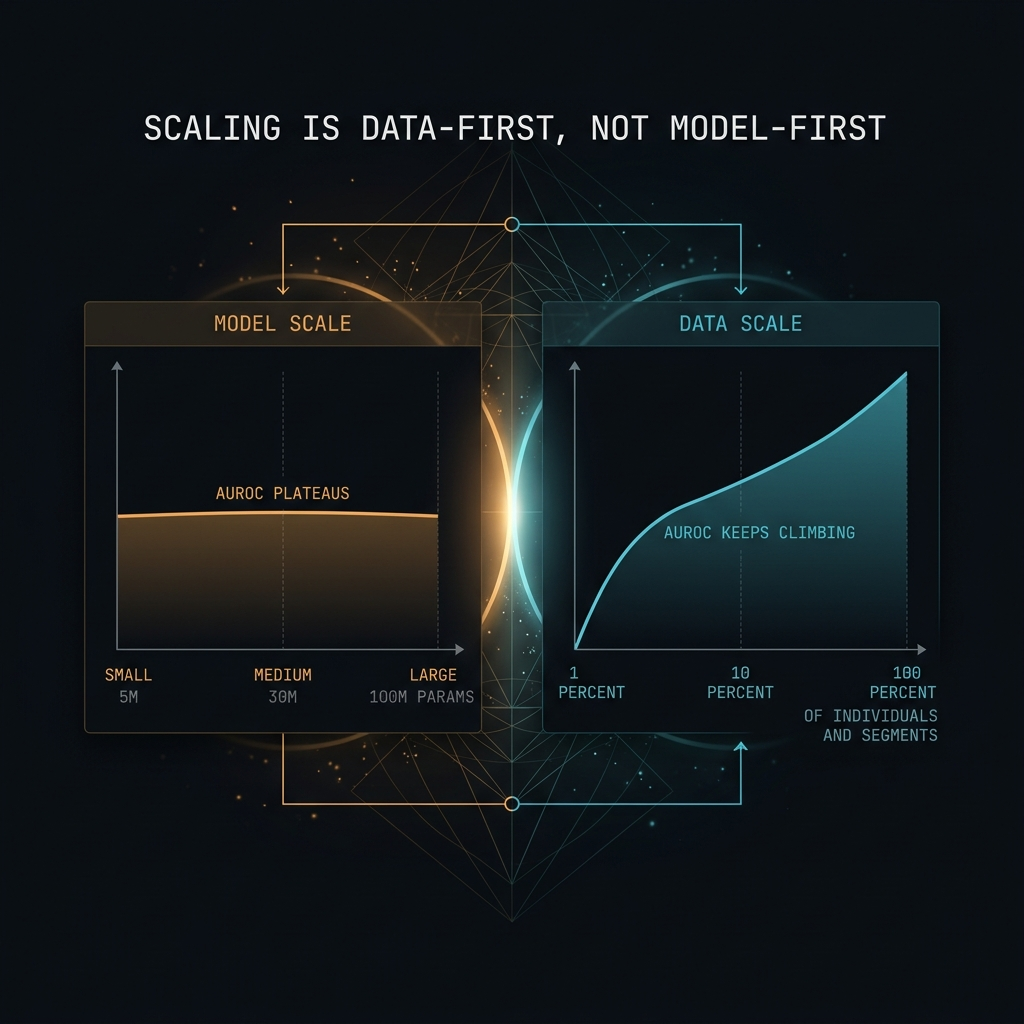
Scaling the data instead — more individuals, more segments per individual, and mixing cohorts — kept improving downstream AUROC on disease prediction, even when the original corpus was already large. The paper's framing is exactly right: motion foundation models are less limited by parameter count than by the diversity and relevance of the pretraining signal. I've seen the same pattern in other modalities — past a fairly modest capacity threshold, curating and diversifying the corpus outperforms adding parameters, and this paper puts real numbers behind that for wearable sensing specifically.
One more finding worth noting for anyone with access to multi-sensor devices: fusing additional streams (extra placements, extra sensor modalities) consistently improved performance, and a model pretrained only on wrist accelerometry still transferred to placements and sensors it never saw during pretraining. That's the practical payoff of training on the largest, most placement-diverse corpus assembled for this so far — the representation generalizes past the specific hardware it was trained on.
Why this is worth your time
If you're building anything on top of IMU or accelerometer data — activity recognition, gait analysis, fall detection, disease risk modeling — Inertia-1 is close to a reference manual for which knobs matter and in what direction. The code is a real, runnable pipeline (python -m inertia1.run, layered YAML configs, a documented preprocessing path for NHANES- and UK Biobank-style data), not just a paper artifact. And the meta-lesson generalizes past wearables: when you're deciding where to spend your next unit of engineering effort on a foundation model, check whether you're actually capacity-constrained before reaching for a bigger model — the data suggests you often aren't.