Memoria brings git's safety net to AI agent memory
Memoria applies git's snapshot/branch/merge/rollback model to AI agent memory, backed by MatrixOne's copy-on-write engine rather than a naming gimmick, and its steering-rules approach is a lesson for any agent tooling.

The failure mode nobody names
When you give an agent persistent memory — across sessions, across users, across products — you have implicitly given it a database. Not a metaphorical one. An actual store of facts, preferences, and corrections that the agent reads on every turn and writes to whenever it decides something is worth remembering. Most memory layers I've used in production — Mem0-style stores, Letta-style agents, a vector index bolted onto RAG — treat that store as append-only: you write a memory, you search it, and if it turns out to be wrong, you either leave it there polluting future retrieval or delete it and hope nothing downstream depended on it.
That's the failure mode nobody names when they talk about agent memory: there's no undo. A bad write from three weeks ago quietly degrades every conversation since, and there's rarely a clean way to ask "show me what changed, and roll it back."
Memoria is the first memory system I've seen take that problem seriously by borrowing an idea we've had a name for since 2005: version control. The project's own framing is direct — "Git made code safe to change. Memoria makes memory safe to change." Snapshot, branch, merge, rollback — for memory, not code.
What's actually under the hood
This isn't a filesystem-snapshot hack wearing git terminology. Memoria is built on MatrixOne's copy-on-write storage engine, and the version-control semantics come from real database mechanics. The team's own arXiv paper on the underlying system describes how MatrixOne's immutable storage and MVCC (multi-version concurrency control) make clone, branch, diff, merge, and revert practical on terabyte-scale tables without ever materializing a full copy. Memoria points that same engine at an agent's memory store, so a "branch" is a cheap, pointer-level fork at the storage layer — not a copied JSON blob — the same trick git itself uses to make branching free instead of duplicating a repository.
On top of that storage layer, Memoria exposes a set of MCP tools any MCP-compatible agent can call: memory_store, memory_retrieve, memory_search (hybrid vector plus full-text), memory_correct, memory_purge, and the version-control-specific set — memory_snapshot, memory_branch, memory_checkout, memory_diff, memory_merge. A self-governance layer sits on top, auto-detecting contradictions and quarantining low-confidence memories rather than silently overwriting them.
The workflow that makes this real, not decorative
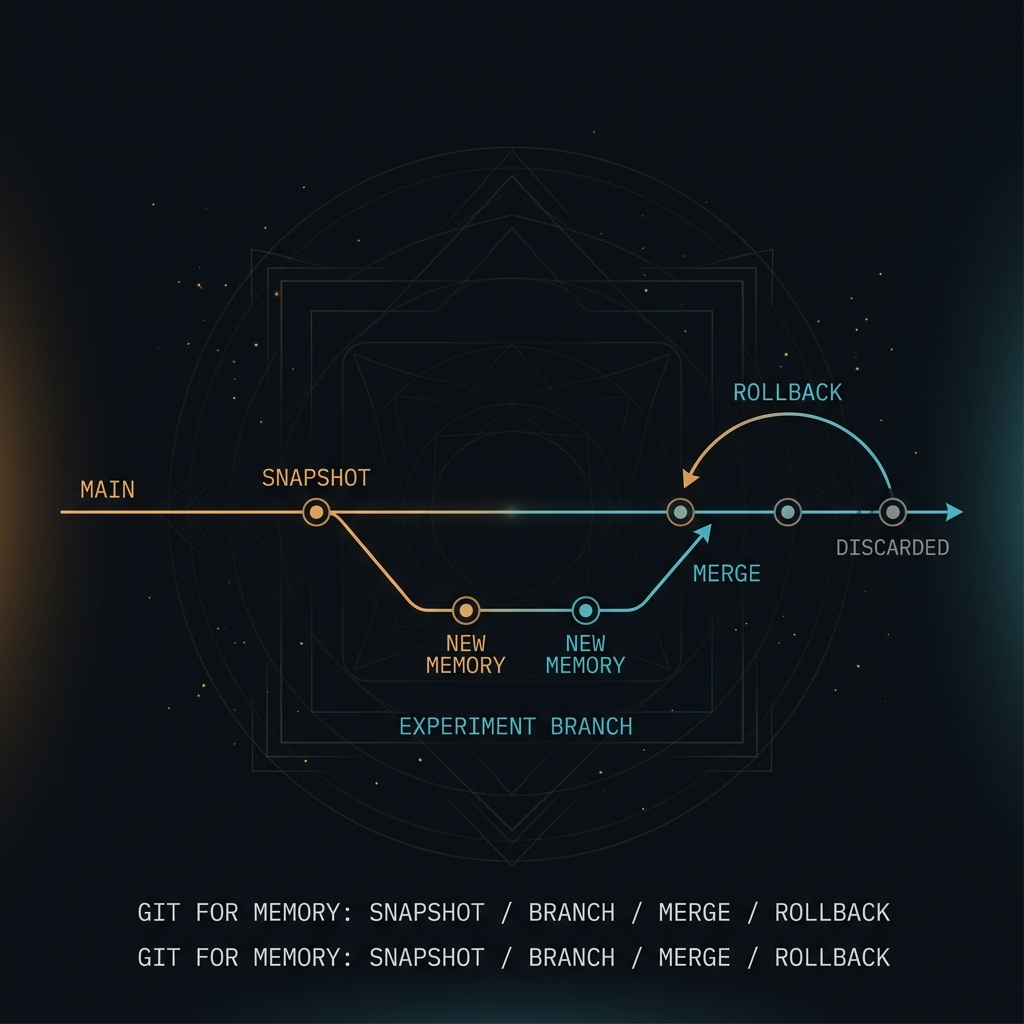 Snapshot, branch, merge, rollback — the same four operations git uses for code, applied to what an agent remembers.
The repo's own demo is a story-writing scenario, and it's a clean illustration of why the git analogy holds up mechanically rather than just rhetorically: an author has accepted plot beats on main, opens a branch to try a different plot direction without touching canon, merges the stronger draft back once it works, and rolls back the last two beats when they don't. Swap "plot beats" for "an agent's belief about a user's preferences" and the same four operations map directly onto real agent work:
- Branch before anything risky. The README's own example is "let's try switching from PostgreSQL to SQLite" — fork the agent's memory, let it experiment and record findings on the branch, then diff the branch against main before deciding to merge or discard.
- Snapshot before you trust an agent to self-correct.
memory_correctupdates a memory in place; a snapshot taken immediately before turns a bad correction into a rollback instead of an archaeology project. - Merge only after validation, not by default — the opposite of how most memory systems handle new information, which is to trust it on write and hope retrieval ranking compensates later.
Why this matters more than the feature list suggests
It's tempting to read Memoria's feature table — version control, semantic search, audit trail, self-governance — against Mem0, Letta, and plain RAG, and treat it as the same category with more checkboxes. I don't think that's the right read. The narrower and more interesting claim is that everything else in that category treats a memory mutation as a single irreversible event, while Memoria treats it as a reviewable change with provenance. That's the same shift version control made to code two decades ago, applied to a part of the agent stack that has been operating without it.
The part of the README that says more about production-readiness than the architecture diagram does is the "steering rules" section. Memoria ships policy documents — covering core memory usage, session lifecycle, memory hygiene, branching patterns, and goal-driven evolution — that the agent itself reads, in whatever rules format its host tool understands (.claude/rules, .cursor/rules, .kiro/steering, AGENTS.md, GEMINI.md). Exposing memory_branch as an MCP tool doesn't mean an agent will branch before a risky change; it means the agent can, if something tells it when to. That distinction generalizes past this one project: tool availability and tool usage are different problems, and the gap between them closes with explicit written policy, not a better tool description.
Where I'd push back
Two things I'd want to see more of before running this as the memory layer under a production agent fleet. First, self-hosting means running MatrixOne itself — a full HTAP database — behind what is conceptually "just a memory store." That's a defensible infrastructure cost for the guarantees it buys, but it isn't nothing, and the managed Memoria Cloud option trades that cost for putting an agent's memory in a third party's hands. Second, automatic contradiction detection and quarantine is exactly the kind of feature that's valuable right up until it has a false positive — a true fact gets flagged as contradictory and quarantined out of retrieval. The saving grace is that the same audit trail making deliberate rollback possible also makes that failure mode diagnosable: you can see what got quarantined and why, and reverse it, which is more than most memory systems offer today.
The idea worth taking regardless
Even if you never run Memoria itself, the framing is worth stealing for any agent memory system you build: treat every memory mutation as a change with a diff, not a fact with a timestamp. Cheap branching for anything you're not sure about, a snapshot before anything that self-corrects, and a merge step that requires validation before a change reaches the memory an agent actually uses in production. Git didn't win because branching was a novel idea — it won because it made branching and merging cheap enough that people stopped being afraid to use them. That's the bar Memoria is aiming at for memory, and it's the right one.