Gemini for healthcare: the constraints are the design
Google Cloud's Gemini for healthcare preview puts agents over EHR, claims and coverage systems with read-only access, inherited permissions and cited answers. I explain why those constraints are the right architecture, and what I would measure before trusting it.
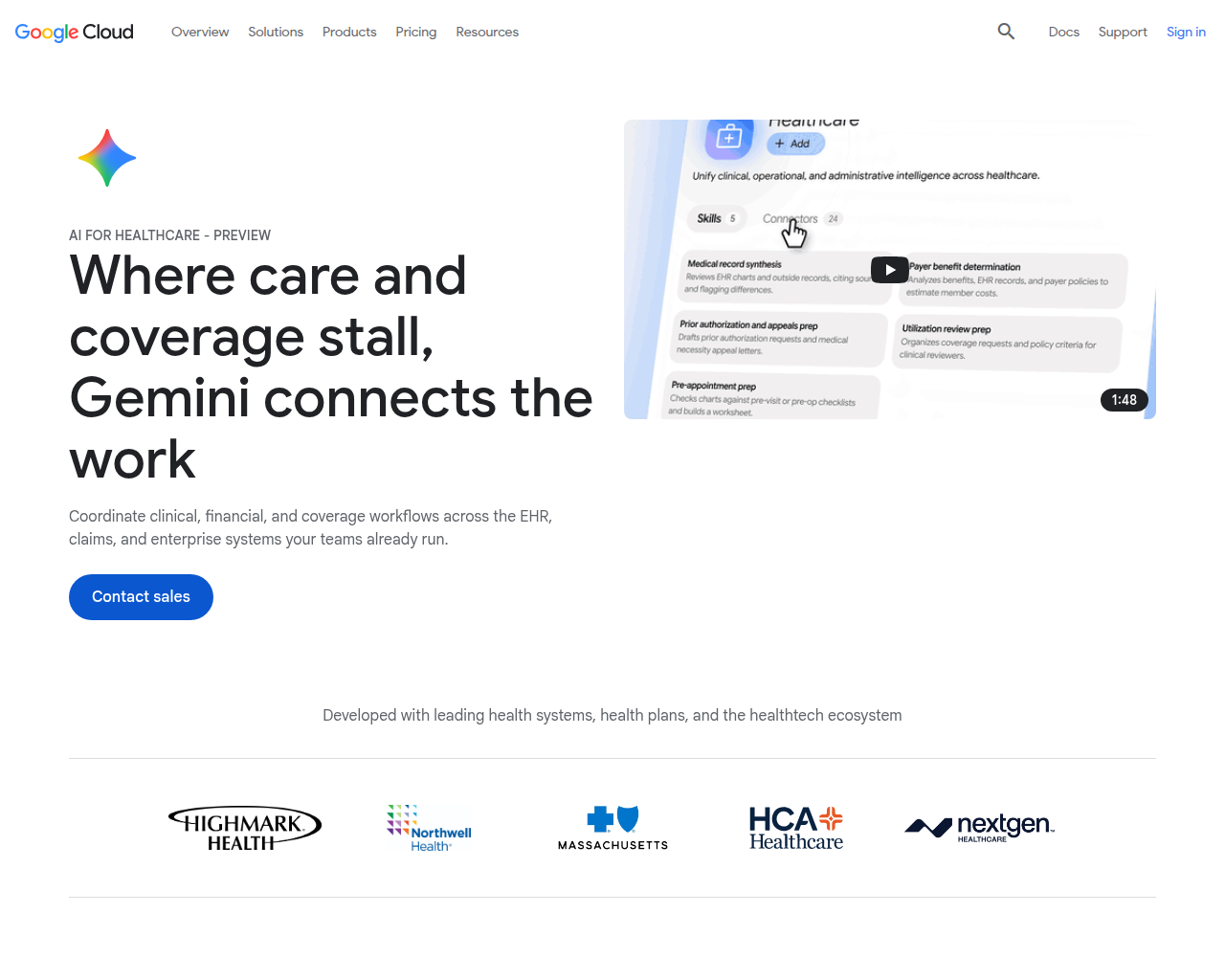
Google Cloud has put Gemini for healthcare into preview, pitched as agents that coordinate "clinical, financial, and coverage workflows across the EHR, claims, and enterprise systems your teams already run." I read the product page the way I read any agentic system spec: skip the adjectives, look for the constraints. In this case the constraints are the most interesting part of the design, and they're worth looking at whether or not you ever buy the product.
What is actually on offer
The page describes five agent skills split across the two sides of the coverage problem:
- Record synthesis: reads outside records (CCDs, referrals, consults) alongside the EHR, flags new allergies, diagnoses or medications, and "cites each finding to its source."
- Appointment prep: surfaces interval events, flags medications, and checks that protocol-required labs, clearances and consents are in place before an encounter.
- Prior authorization: assembles chart evidence against health plan criteria, flags documentation gaps before submission, and drafts a source-cited appeal "when the record supports it."
- Utilization review: for payers, finds the documentation in a request that meets plan medical policy, including exceptions intake can miss.
- Benefits and coverage: combines benefit booklets with live eligibility, network status and deductibles to produce cost estimates.
Underneath sits a connector catalogue: Epic and Oracle Health over read-only access (Epic described as "read-only FHIR R4 access to conditions, meds, labs, and notes"), InterSystems FHIR, Verato for patient identity resolution, Optum and TriZetto for eligibility, ICD-10 and RxNorm for coding, CMS Coverage for Medicare NCDs and LCDs, the NPPES NPI registry, and the usual enterprise surfaces (Microsoft 365, Google Workspace, Salesforce, ServiceNow, UiPath).
The architecture is the argument
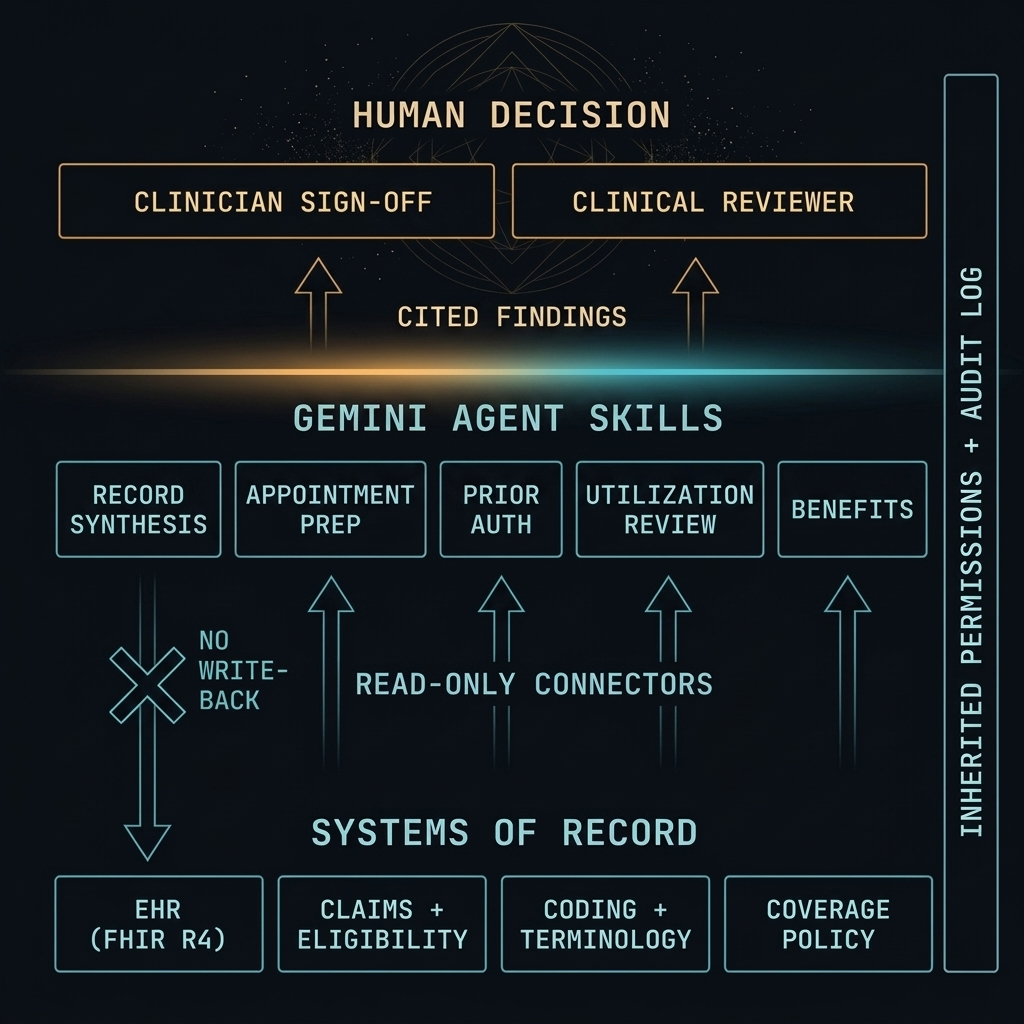
Strip out the vendor names and the shape is a three-layer system. At the bottom are the systems of record, which stay where they are. In the middle is a reasoning layer that can read from them but, for the EHR at least, cannot write. At the top a human makes the decision. The page says this outright: "Read-only to EHR: No write-back to the chart," and on the payer side, "Decisions stay with experts."
I think this is the correct shape for a first deployment of agents in a regulated domain, and I'd defend it on engineering grounds, not just compliance grounds.
Read-only protects the chart, not the patient. An agent with no write-back cannot corrupt the record of truth: it cannot place an order, edit a medication list or overwrite a note. That is a real boundary, and it means you can be wrong in the middle layer without corrupting the bottom one. It is not a clinical safety guarantee. A summary that misses a new allergy or misattributes a diagnosis can still cause irreversible harm if a clinician acts on it. Read-only narrows the failure modes to bad information; the human decision layer and the evaluation work below are what have to catch that.
Inherited permissions narrow the authorization problem. The page states that connectors "respect existing identity and role-based access rules so users only query records they are already authorized to view." The alternative, a service account with broad access that the agent filters down, is a common source of data leakage. Delegating authorization to the existing system is less flexible and easier to audit. It does not remove the risk: the agent still inherits any over-broad roles already in place, and it can move data a user is allowed to see into places it should not go, such as a drafted appeal, a shared document or a log. Those paths need their own controls.
Citations change what the reviewer is doing, without making review easy. "Answers cite their sources" sounds like a feature, but it's really a change to the review task. A reviewer looking at an uncited summary has to re-derive it from scratch. A reviewer looking at a cited one has a starting point, but still has to check that each source actually supports the claim, that the claim fits the patient's clinical context, and that nothing important was left out. Citations make the first of those faster; they say nothing about the third.
Grounding in live policy, not model memory
One line on the connector list deserves more attention than it will probably get: the CMS Coverage connector "grounds coverage checks in current published Medicare NCDs and LCDs rather than static model knowledge."
That's the right instinct. Coverage policy, formularies, network status and deductibles all change on a schedule that has nothing to do with a model's training cutoff. A model that has memorized last year's LCD is confidently wrong in a way that is hard to catch. Treating the model as a reasoner over retrieved, current documents, and never as the store of record, is the pattern I'd insist on in any domain where the ground truth is versioned.
What I would want to measure before trusting it
The page is a product page, so it doesn't publish evaluation results, and I won't guess at them. These are the questions I'd ask in a pilot:
- Citation fidelity. Does each cited source actually support the claim attached to it? A citation that points to the right note but the wrong sentence is worse than no citation, because it lends the claim credibility it hasn't earned. This needs to be scored directly, on a sample, by clinicians.
- Recall on documentation gaps. Flagging gaps before a prior auth submission is only valuable if the miss rate is low. A false negative here turns into a denial that the team assumed had been pre-checked. I'd want sensitivity reported separately from precision.
- Identity resolution upstream. Record synthesis depends on joining records that belong to the same patient. Verato is in the connector list for exactly this reason. Merge errors at that layer flow straight into a confident, well-cited summary of the wrong person's allergies.
- Freshness and failure modes of connectors. When a live eligibility call times out, does the agent say so, or does it fall back to the benefit booklet without telling anyone? Silent degradation is the failure mode I'd test hardest.
Both sides of the same transaction
The detail I keep returning to is that this product serves providers drafting prior authorizations and appeals, and payers reviewing them, with overlapping connectors (Optum, CMS Coverage) on both sides. If both ends of a prior auth exchange end up running agents grounded in the same policy sources, the friction in that exchange could drop considerably, or it could turn into an automated back-and-forth of evidence packets. Which one we get depends less on the model than on whether both sides keep the human decision layer as real as the page describes.
The page includes statements from Blue Cross Blue Shield of Massachusetts, Highmark Health, ASCO, Northwell Health and HCA Healthcare, mostly framed as exploration. That fits a preview. What I'll be watching for is whether the read-only, cite-everything, human-decides constraints hold once the product moves past preview and customers start asking for write-back. Those constraints are what make it trustworthy, and they'll come under pressure as soon as the first version proves useful.