Gemini Decisions API: when the right model call is a classifier, not a writer
Google's new Gemini Decisions API scores up to 1,000 closed-set questions against one multimodal input in a single forward pass and returns calibrated probabilities instead of text. Here is what shipped, why scoring beats generating for most agent control decisions, and how I would validate it before trusting the confidence scores.
Google has shipped a new endpoint in the Gemini API that does not generate text. The Gemini Decisions API, backed by a new model called Gemini Decision 1 (gemini-decision-1), takes one multimodal input and up to 1,000 closed-set questions, and returns probabilities. No answer text, no reasoning trace: just a distribution over the options you defined, plus a confidence score.
That sounds like a small product. I think it is one of the more useful primitives released this year for anyone running agents in production, because most of the calls inside an agent loop are not really generation problems.
What shipped
From the announcement:
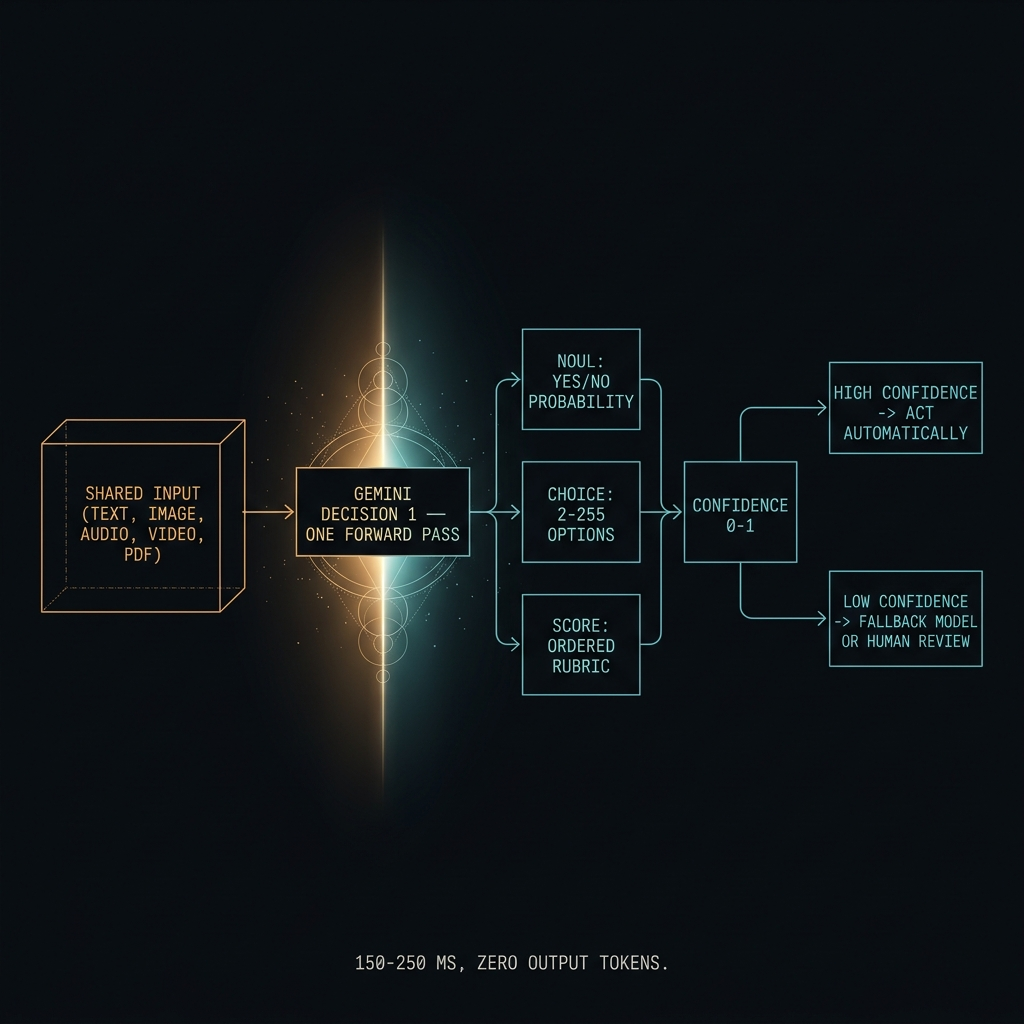
- One shared input, many questions. A single input of text, images, audio, video or PDFs, up to 256K tokens, evaluated against up to 1,000 independent questions in one request.
- Three question types. A yes/no type (listed as
noulin the announcement) that estimates the probability a condition holds;choice, which selects among 2 to 255 options and returns normalized probabilities for every candidate; andscore, which grades against an ordered rubric starting at 0 and returns a continuous weighted score plus per-level probabilities. - A confidence score from 0 to 1 on every answer, explicitly so your code can send ambiguous cases to a fallback or a human reviewer.
- Latency. Google reports 50 to 100 ms of median model compute and 150 to 250 ms end to end, for contexts up to 16K tokens, and says latency stays nearly flat from 1 to 100 questions per request.
- Pricing. $0.10 per 1M input tokens and nothing for output, because there is no output. The shared input is billed once per request regardless of how many questions you ask; each question only adds its own instruction and criteria tokens. Google puts it at nearly 5x cheaper than Gemini 3.5 Flash-Lite through the Interactions API on its shared benchmark suite.
The input uses the same Content block format as the Interactions API, so it fits into existing Gemini code without much rework. Support is in the google-genai SDKs, and integrations are rolling out across OpenRouter, LangChain, Vercel, LiteLLM, Pydantic AI, Pipecat, LiveKit and OpenCode.
Scoring instead of generating
The mechanism is the interesting part. A generative model answering "is there a spill on this counter, yes or no" still decodes token by token, and you then parse the text, hope it obeyed the format, and perhaps read logprobs off the first token if the provider exposes them. Gemini Decision 1, in Google's words, "scores your candidate options in a single forward pass." The answer set is fixed in advance, so the model only has to assign probability mass across that set.
Three consequences follow, and they are the reason I take this seriously.
First, adding questions gets much cheaper, though not free. You pay to encode the shared input once, and each extra question adds its own billable instruction and criteria tokens. Google reports nearly flat latency from 1 to 100 questions, measured on contexts up to 16K tokens; it gives no such figure for requests near the 1,000-question limit, so I would measure that myself. That changes how you design checks: instead of one omnibus prompt asking a model to evaluate twelve policy rules and return JSON, you ask twelve narrow questions and get twelve independent probabilities.
Second, the output is structurally valid by construction. There is no malformed JSON, no option outside the set, no "I think the answer is probably B, but..." to parse. A whole category of glue code and retry logic goes away.
Third, and most important, you get a number you can threshold. This is where calibration matters.
Calibration is the actual product
Google says Gemini Decision 1 leads its benchmark suite, spanning agent routing, reasoning, ranking and multimodal understanding, with the lowest calibration error. I cannot verify that from the post, but it is the right thing to optimize, and it is worth being precise about why.
A classifier is calibrated if, across all the cases where it says 0.8, it is right about 80% of the time. In physics, an uncalibrated instrument does not give you a measurement; it gives you a reading with an unknown systematic error. The same holds here. Good calibration makes a routing threshold something you can reason about, but the threshold alone does not tell you the outcome. Setting it at 0.9 does not mean 10% of accepted cases will be wrong, or any particular review volume. The error rate among accepted cases depends on how your traffic's scores are distributed above the cutoff and on how well calibrated they are in that region; the review volume depends on how much of your traffic falls below it. Both are properties of your data, not of the number 0.9. It also matters which number you threshold: the API returns per-candidate probabilities and a separate 0 to 1 confidence score, and the two are not interchangeable. Without calibration, the threshold is guesswork that drifts every time the input mix changes.
That is the caveat I would put ahead of everything else. Calibration on Google's benchmark suite is not calibration on your traffic. Before putting this in a control path, I would build a few hundred labeled examples from real production inputs, held out from any tuning, plot a reliability diagram for both the candidate probabilities and the confidence score, and pick thresholds by measuring accepted-case error and review volume directly on that set rather than inferring them from the announcement. If it is off, a temperature or isotonic correction on top of the returned probabilities is cheap to add.
Where it fits in an agent stack
The use cases Google lists are telling. It describes teams inside Google using the API as "a low-latency control plane":
- Model routing in Gemini Notebook, classifying query intent to pick a model tier and thinking level, with up to 40% lower latency on everyday queries.
- Stitch, using it to generate playable wireframes of a product flow and apply voice or tap edits almost instantly.
- CC from Google Labs, picking an emoji reaction from a palette of more than 200 options.
- A safety layer for MCP tools in Google Search, detecting adversarial behavior and content within the latency budget.
Those map cleanly onto the parts of an agent system I most often see written as full LLM calls: tool selection, guardrails, retrieval relevance grading, escalation decisions, and LLM-as-judge rubrics in evaluation pipelines. Each is a bounded choice. Each currently pays generation latency and output-token cost for what is ultimately a pick from a short list. Moving them to a scoring endpoint makes the generative model the expensive, rare path and the decision layer the cheap, frequent one, which is the right shape for a production system.
What I would watch for
A few honest limits, none of which reduce the value of the primitive:
- You must enumerate the options. If the right answer is not in your set, the model will still distribute probability across the wrong ones. Low confidence helps, but an explicit "none of these" option is worth adding to most
choicequestions. - Questions are independent. That is a feature for cost, but it means no chaining. Conditional logic, such as "if A, then which of B, C or D", belongs in your code or in a second request.
- The latency figures are for contexts up to 16K tokens. The input limit is 256K, and I would measure long-video or large-PDF cases myself rather than assume the same 150 to 250 ms.
- Guardrails inherit their inputs. Using it as a safety layer is sensible, but the classifier reads the same adversarial content it is judging. Treat it as one layer, not the boundary.
My take
The Decisions API makes explicit something practitioners have been approximating with constrained decoding and first-token logprobs: many calls in an AI system are closed-set judgments, and they should be priced, timed and measured like classifiers rather than like writers. A calibrated probability you can threshold is worth more in production than a fluent paragraph you have to parse.
If you run agents, a useful exercise is to list every LLM call in your pipeline whose output you immediately reduce to one of a few values. Those are the candidates. The announcement points to Python, JavaScript and REST guides and a no-cost tier in Google AI Studio, which is enough to run the reliability check on your own data before committing.