A spectral shortcut for protein dynamics simulation, and its catch
DynaMode denoises protein motion trajectories in the frequency domain instead of time, separating slow conformational modes from fast atomic jitter to sample full molecular dynamics trajectories nearly two orders of magnitude faster than competing generative models — though the raw output needs a costly post-hoc fix before it's structurally valid.

Molecular dynamics (MD) simulation is still the reference method for understanding how proteins move — how they fold, breathe, and shift between conformations that matter for binding and allostery. It's also expensive: numerically integrating Newton's equations over femtosecond steps to observe motion on microsecond timescales doesn't scale to the ambitions of modern structural biology. That's the gap a new line of "MD emulator" models is trying to close, and a paper out of Oxford, Copenhagen, and Bayer — Spectral Diffusion for Protein Dynamics (Phipps, Cagiada, Villalba, and Deane) — makes a genuinely interesting move: instead of generating protein trajectories directly in time, it transforms the trajectory into the frequency domain first, and diffuses there.
The problem with treating motion as snapshots
Most recent generative approaches to protein dynamics — diffusion and flow-matching models finetuned on MD data — treat an ensemble as an unordered set of conformations. Repeatedly sample a structure predictor conditioned on some perturbation, and you get a set of plausible states. What you don't get, unless you build it in deliberately, is temporal order: which state came before which, how fast the transition was, whether the motion is autocorrelated the way real dynamics is. That's a real limitation if what you want is a trajectory you can query the way you'd query an MD run — for relaxation behavior, coupled motions, or how a residue's flexibility depends on temperature.
The paper's answer isn't a bigger model. It's a change of representation.
A change of basis: diffuse in frequency, not time
Take a protein's per-residue Cα displacement from a reference structure over a window of frames, and apply a Discrete Cosine Transform (DCT) along the time axis, per residue and per x/y/z channel. The result is what the authors call a spectral volume — the same trajectory, re-expressed as frequency coefficients. Low frequencies capture slow, collective conformational motion; high frequencies capture fast, local jitter. DynaMode, their diffusion model, denoises this spectral volume directly, conditioned on the input structure and the simulation temperature. An inverse DCT turns the denoised spectrum back into an ordinary trajectory of structures.
The motivation is a basic fact about MD trajectories: they're highly autocorrelated in time, spanning wildly different scales — slow domain rearrangements sitting next to fast side-chain rattling. A time-domain model has to represent both scales directly, typically through deep autoregressive or dilated architectures. Projecting onto an orthogonal frequency basis does that scale separation for free, the same logic that makes normal-mode analysis a natural tool in structural biology, applied here generatively instead of analytically.
There's a piece of physics under this that goes beyond intuition. By Parseval's identity, the sum of the squared non-DC spectral coefficients for a residue equals that residue's temporal variance about its mean position — which is exactly Root Mean Squared Fluctuation (RMSF), the standard measure of per-residue flexibility. A model trained to reproduce low-frequency spectral volumes is, by construction, reasoning over flexibility, not as an afterthought metric but as something recoverable analytically from the training target itself.
The obvious frequency-domain candidate is the ordinary Discrete Fourier Transform, but the paper uses the DCT instead: the DFT implicitly assumes the signal is periodic, wrapping a window's end back to its start. MD windows aren't remotely periodic, especially under non-equilibrium conditions like high-temperature unfolding — one of the regimes this model trains across, 300–450K — so that assumption introduces spectral leakage and Gibbs-phenomenon-like ringing at the window's edges. The DCT instead mirrors the signal at its boundaries, and the paper's ablations confirm this matters: DCT reconstructions are measurably more accurate than DFT ones near trajectory boundaries, and the gap widens at higher temperatures, exactly where dynamics are least periodic.

Architecture and training
DynaMode's network is a spectral convolution architecture inspired by Fourier Neural Operators: instead of full self-attention over the whole spectral volume, it splits the frequency-mixing operation into blocks that respect coarse timescale groupings, plus a dedicated low-frequency calibration branch tuned to the DC and low-k amplitudes that carry most of the RMSF signal. It predicts the clean spectral volume directly rather than the added noise, using a noise schedule with per-frequency-band scaling so the reverse process denoises low frequencies (global shape) before high frequencies (local jitter).
Training data is mdCATH: 5,398 monomer domain MD trajectories across five temperatures (320–450K), five replicates each, up to 450 frames at 1ns spacing, split by sequence identity into 4,304/538/495 train/val/test domains, with 256-frame windows of up to 576 residues, rigid-core aligned to strip out global rotation and translation while preserving genuine large-scale motion between subunits.
What the numbers say
On the mdCATH held-out test set, DynaMode reaches an RMSF Pearson correlation of 0.844 and leads competing methods — MDGen, AlphaFlow-MD, TEMPO — on pairwise RMSD and global RMSF correlation. On ATLAS, an out-of-distribution benchmark at 300K, below DynaMode's training range and a dataset the baselines were partly trained on, its RMSF correlation drops to 0.734 and it trails those in-distribution baselines on most metrics — an expected result for a genuinely zero-shot temperature.
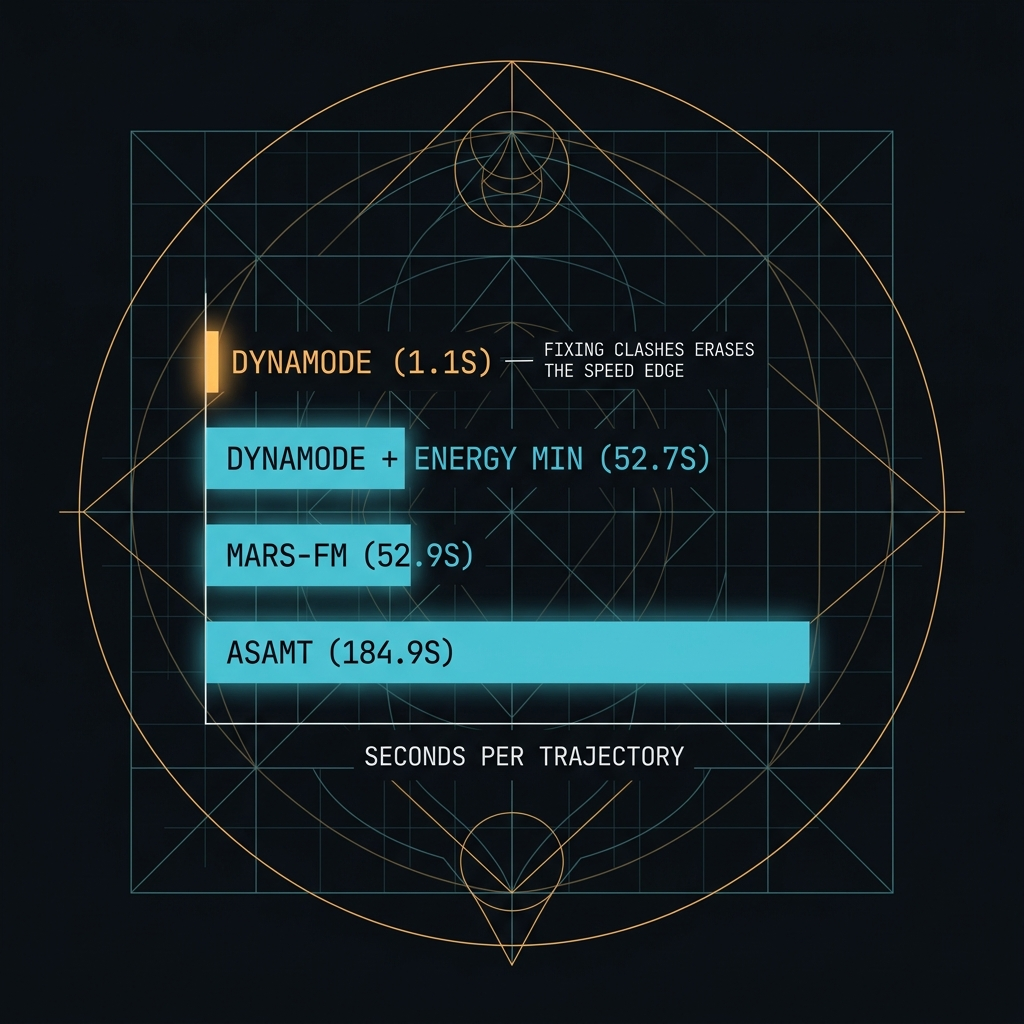
The more striking number is speed: DynaMode samples a full 256-structure trajectory in about 1.1 seconds on a GH200 GPU, roughly two orders of magnitude faster than the next-best ensemble sampler tested, aSAMt, at 184.9 seconds.
The catch
That speed comes from a specific omission: the spectral representation decorrelates the temporal signal but does nothing to enforce 3D spatial plausibility, so DynaMode's raw output has real steric clashes — nonbonded Cα atoms placed closer together than physically possible. A post-inference energy minimization step resolves most of these, but costs roughly 50 times the sampling time, pushing DynaMode from 1.1 to 52.7 seconds per trajectory — still faster than aSAMt, but no longer a two-orders-of-magnitude story. There's a related trade-off the authors are direct about: DynaMode wins on temporal coherence and speed, while spatial ensemble samplers win on structural validity and conformational diversity, because they spend their capacity on 3D geometry instead of on time.
Why this is worth noticing
The generalizable idea here isn't really about proteins. Changing the coordinate system a model operates in can buy both efficiency and an inductive bias that a bigger model in the "natural" coordinate system wouldn't get for free — the same reason latent-space diffusion outperforms pixel-space diffusion, or why a well-chosen Fourier feature basis speeds convergence in coordinate-based networks generally. Here, the basis choice happens to line up with a real physical quantity, since RMSF falls out of Parseval's theorem for free — the kind of alignment worth hunting for when picking a representation, not just a model size. The honest reporting of where the shortcut breaks down — spatial validity, non-equilibrium leakage, the largely erased speed advantage after cleanup — deserves as much attention as the headline numbers. It's usually the repair step, not the sampling step, that decides whether a generative shortcut is actually usable in practice. Code is available at the DynaMode repository for anyone who wants to run it directly.