Decoupled predictive decision making: a tabular foundation model as the agent's decision head
DPDM uses a frozen LLM only to encode an agent's task history and hands the actual decision to a frozen tabular in-context predictor, LimiX-2. The results are strong and the ablations are careful, but the baseline set leaves the key question open.
Most agent stacks I see in production make every judgment the same way: put the task, a handful of past examples and the candidates into a prompt, then ask the language model what to do. Which tool applies? Is this reasoning step wrong? Which response is better? The model reads the request, infers patterns from the examples and writes the answer, all in one forward pass.
A new paper from Stable AI and Tsinghua, Decoupled Predictive Decision Making: A Shared Conditional Predictor for Agents (Mo, Zhang, et al.), argues that one model should not do all three jobs. Its proposal, DPDM, uses the LLM only as a frozen encoder. A separate frozen model pretrained on structured data makes the decision from labeled history. That model is LimiX-2, a tabular in-context learner in the same family as TabPFN. I think the idea deserves attention, and I also want to be precise about what the evidence does and does not show.
The architecture
DPDM treats each agent decision as conditional prediction. The task defines a record (context, visible trajectory, candidate descriptions) and a target (tool applicable or not, step correct or not, preferred candidate). The history is a set of past records with their observed targets. The question is then a familiar one: given these labeled rows, what is the label of this new row?
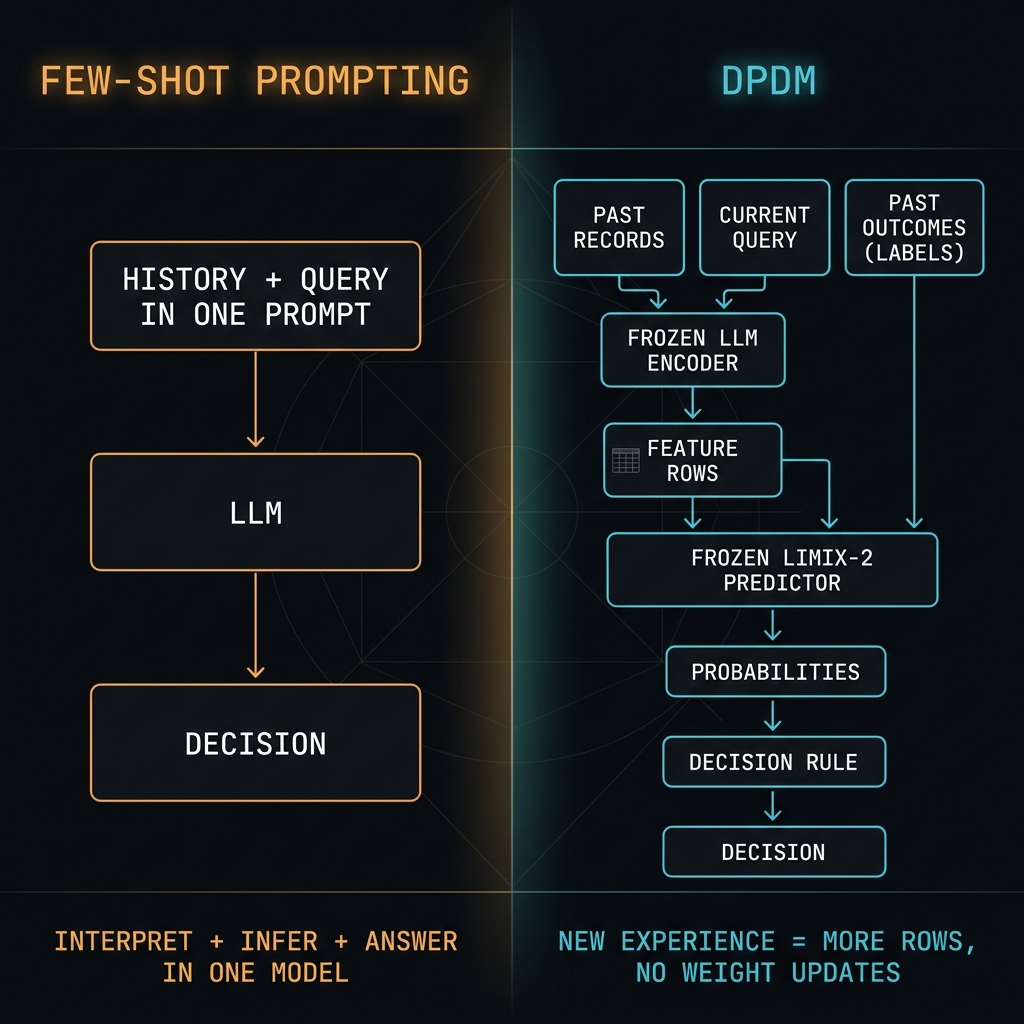
The pipeline has four parts:
- Semantic encoder. A frozen LLM (Qwen3.5 at 4B, 9B or 27B, or Llama-3.1-8B) encodes each record on its own. The authors take the final hidden state at the last prompt token, L2-normalize it and compress it with PCA to at most 32 dimensions.
- Feature adapter. Those dimensions are combined with TF-IDF lexical features and any native numeric or categorical fields. The transforms are fitted only on historical inputs and refitted as history grows.
- Conditional predictor. LimiX-2 receives the historical rows, their labels (which never pass through the LLM) and the query row, then returns class probabilities. One checkpoint serves every task.
- Decision rule. Pick the highest-probability valid candidate.
Neither neural model is updated at any point. Adapting to new experience means appending rows. That is the core of the design, and the reason I find it interesting. It turns "learning from experience" into a component you can swap out and benchmark separately, instead of a capability buried inside the prompt behaviour of whichever LLM you happen to run.
What the numbers show
The evaluation covers 50 benchmarks and 82 task configurations across agent tasks, knowledge QA, evidence consistency, safety and language understanding. Headline results from the paper's Table 1 and Section 3:
- Mean accuracy. With Qwen3.5-27B as encoder, DPDM reaches 84.92% against 78.80% for few-shot prompting. With Llama-3.1-8B it goes from 41.87% to 77.57%.
- Matched histories. With identical histories and queries, the 27B gap narrows to 82.33% vs 78.80%. This is the comparison I trust most, and the gain holds up.
- Tool-use step assessment. On ToolPRMBench BFCL, accuracy rises from 42.59% to 76.85%. On ToolSandbox, it rises from 68.04% to 96.91%.
- Imbalanced histories. On BIG-Bench Mistake, where most steps are correct, mean balanced accuracy rises from 59.86% to 74.37%. On object tracking, the 27B setup correctly rejects 93 of 104 incorrect steps, against 42 for prompting. This failure mode matters in practice: a few-shot judge that has mostly seen "correct" learns to say "correct."
- Growing history. Accuracy rises at every step from 32 to 8,192 records for all four encoders.
The ablations are the most convincing part of the paper. Shuffling the historical labels drops accuracy from 80.71% to 50.13%, about the same as always predicting the most frequent label. So the predictor really is learning input–target relationships. Sixteen distinct records repeated eight times reach 64.79%, while 128 distinct records reach 80.71%. Removing the semantic features at a 512-record ceiling drops accuracy from 80.42% to 63.95%. The LLM representation carries real signal, but a lot of the work is done by TF-IDF and the tabular learner.
Where I would push back
After reading the abstract, I wanted more on baselines and cost. The full paper answers part of that: it includes the matched-history comparison and a GPU-time study (DPDM takes 19.7% of the full-pipeline time of cached few-shot prompting on five tasks). Some gaps remain.
The baseline set is narrow. Every comparison is against prompting the same LLM, plus an external decision API. The missing baseline is the obvious one: logistic regression, kNN or a gradient-boosted tree on the same feature rows. If a linear probe on PCA-32 embeddings plus TF-IDF gets most of the way, the contribution is "use embeddings plus a classifier", not "use a tabular foundation model." The value of LimiX-2 over a fitted head is the claim I most want isolated, and the text I read does not isolate it. Methods closer to the stated motivation, such as ExpeL-style insight extraction or retrieval of similar trajectories, are discussed but not run.
The prompting baseline is weak in places. For three of the four models, few-shot prompting scores below zero-shot. One plausible explanation is label bias, a known few-shot effect the paper cites, though the experiments do not establish it as the cause. Still, it means some headline gains measure how badly long prompts degrade small models, not how well DPDM learns. The 27B matched-history number (+3.5 points) is the more honest estimate of the method's edge.
Unequal history budgets. The main table lets each method use its largest completed history. On FaithDial, DPDM uses 8,192 records against 512 for prompting. The authors state this openly, and scaling to large histories is a real advantage. Just read the headline as "architecture plus budget", not architecture alone.
The cost picture is partial. The 80% GPU-time reduction comes from five tasks and 256 queries each. It does not cover memory, latency per decision, or the cost of collecting labels, which I expect to dominate in deployment.
Scope. Every task here is a labeled classification or selection with a clean target. Most agent decisions in production have delayed, noisy or missing outcomes. DPDM is only as good as the label stream you can provide.
Why it matters anyway
Even with those caveats, the architectural argument holds up. A language model is a strong reader. It is not obviously the right learner for "given the last 4,000 tool calls and whether they worked, should I make this one?" A pretrained tabular predictor is built for exactly that question, under the paper's tested context, memory and runtime limits it used far larger histories than prompting could, and it adapts without fine-tuning. For production teams, the practical takeaway is to log decisions with outcomes as structured rows, because that ledger becomes a training-free learning signal.
If I were adopting this, I would start where the paper is strongest: process-reward-style judgments (tool-step correctness, code critique) with imbalanced labels, and with a logistic-regression head on the same features as my own control. If the tabular foundation model beats that control, then the decoupled design has earned its place.