Beam: what a 100M-rollout asynchronous RL run looks like from the inside
Reflection's Beam technical report describes a 501B-total, 23.4B-active MoE with a 1M-token context and one of the largest open-lab RL runs to date. Its lasting value is the engineering discipline it documents, from scaling-ladder gates to async RL staleness.
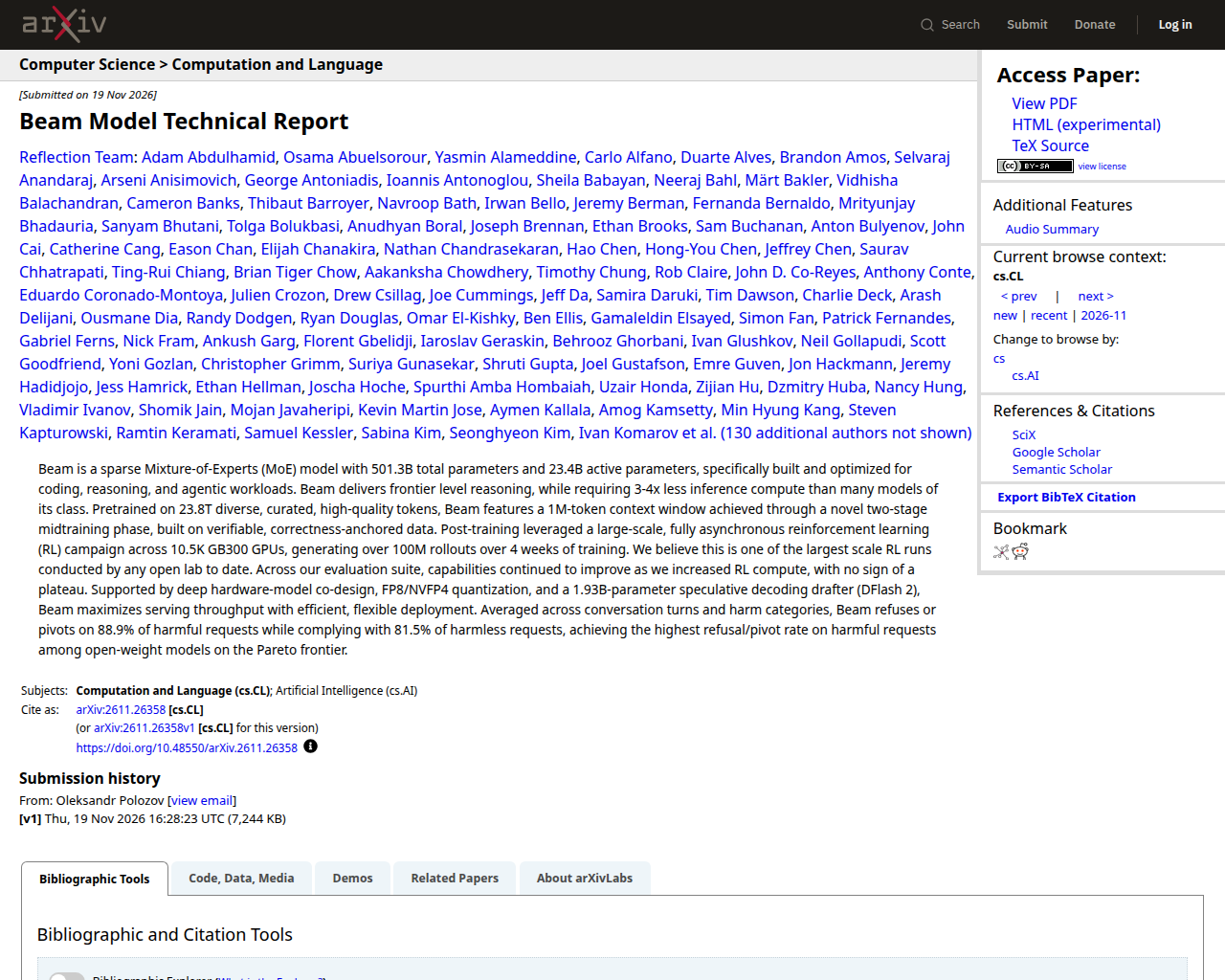
Reflection has published the Beam Model Technical Report, describing its first open-weight model: a sparse Mixture-of-Experts with 501.3B total parameters and 23.4B active per token, built for coding, reasoning, and agentic work, with a 1M-token context window. The headline number is the post-training run: a fully asynchronous reinforcement learning campaign on 10.5K NVIDIA GB300 GPUs that generated more than 100M rollouts over four weeks.
Benchmark tables age quickly. What I think will last from this report is how much engineering it documents, from data curation through serving. Frontier-scale RL rarely gets written up at this level of operational detail, and that is why I read it end to end.
The shape of the model
The configuration is conservative in the right places. Beam has 52 layers, of which 49 are MoE layers with 256 experts each and 8 routed per token, and there are no shared experts. Attention interleaves local and global layers at a 5:1 ratio, with a 512-token sliding window on the local layers. GQA pairs 48 query heads with 8 KV heads. Local layers use RoPE and global layers use no positional encoding at all (NoPE). GQA and the 512-token window on five of every six attention layers are what shrink the KV cache, and at 1M tokens of context the KV cache decides whether the model is servable. Expert routing and NoPE serve other ends.
Two stability details stood out to me as a physicist, because both are about keeping magnitudes bounded rather than hoping they stay bounded:
- Depth-scaled residuals (DSRes). In a pre-norm network the residual stream is a running sum of sublayer outputs, so its norm grows with depth. Beam rescales the sum by 1/√n, where n is the number of accumulated sublayers. If the sublayer outputs are roughly uncorrelated with similar RMS, the stream's RMS then stays roughly constant. It is the familiar random-walk normalisation applied to a residual stream, and it can be computed recurrently without ever materialising the full sum.
- A cosine-decayed expert-bias update. Auxiliary-loss-free load balancing nudges per-expert router biases at a fixed rate. The authors argue that a constant rate becomes harmful once routing has converged, so they hold it constant through warm-up and then cosine-decay it to zero. They report the busiest expert's load ending pretraining at 1.04x the uniform load.
They also keep the residual stream in FP32 and add elementwise gated attention, because they saw activation outliers after the attention output projection even with QK-norm in place.
Scaling discipline
The part of the report I would most like teams to copy is its acceptance criterion. Every pretraining intervention, whether architectural, data, or numerical, is tested across a ladder of model sizes, roughly 300M to 6B active, before it reaches the 23B target. It is accepted only if it improves compute efficiency, defined as the FLOPs the fitted baseline scaling law would need to reach the intervention's loss, divided by the FLOPs actually spent. Changes below about 5% are treated as noise.
They add a refinement called data-limited subsampling. Smaller tiers get proportionally less unique data, so they repeat sources about as many times as the final run will. Without it, a small model trained on fresh tokens tells you nothing about how the large model behaves under repetition. The final mixture of 23.8T training tokens drawn from 13.7T unique tokens averages 1.73 epochs, so repetition is a real factor, not a footnote.
The data work is just as careful. They found that canonical MassiveWeb heuristic filters would have removed 80 to 88% of their curated web-math, web-code, and web-STEM tokens, so they partition by domain first and filter each domain separately. Their in-house quality classifier reaches 0.949 Keep-AUC on a natural holdout, against 0.595 for DCLM's fastText classifier, and gives about 1.35x compute efficiency on web validation in ladder ablations.
The pipeline end to end

The structure is worth spelling out. Pretraining ran in under four weeks on 6,144 GB300s, reaching 92.3% goodput toward the end and 21% MFU in steady state. Two-stage midtraining then extended effective context to 1M tokens using what the authors call correctness-anchored data. Post-training is not a single model. An agentic expert is trained with heavy RL, and an alignment teacher is trained for safety and calibrated abstention. The two are merged through multi-teacher on-policy distillation. Serving then layers on FP8 and NVFP4 quantization and DFlash 2, a 1.93B-parameter speculative-decoding drafter.
The RL run
The RL numbers are the reason this report is being discussed. The platform ran 110K concurrent rollouts, pushed 12-second weight updates to the inference fleet, and packed batches at 99.99%. The authors say tool use, web browsing, and problem decomposition emerged from this training, and that capabilities "continued to improve as we increased RL compute, with no sign of a plateau."
I would read that last claim carefully. "No plateau" over four weeks of one run is a statement about where they stopped, not proof of an asymptote. Asynchronous RL at this scale also forces a tradeoff that the report names directly: throughput against policy freshness. With 110K rollouts in flight, many trajectories are generated by a policy several updates stale. The report lists sampling consistency, routing and numerical consistency between trainer and server, and reward integrity as first-class concerns. In my experience these are exactly where large agentic RL runs fail quietly, through a router that picks different experts in inference than in training, or a verifier the policy learns to game. The report's sections on adversarial verifier checks, guessability filters, and reward-hacking probes are where I expect most of its practical value to sit.
Safety and the over-refusal result
Under Reflection's Open Safety Framework, Beam is rated Limited in all four systemic-risk categories: biological, chemical, loss of control, and cyber offense. On their in-house Iris evaluations it refuses or pivots on 88.9% of harmful requests and complies with 81.5% of harmless ones. The finding I would take into production work is a different one. Scaling the alignment teacher from 100B to 501B parameters cut false-positive over-refusals by 48.7% under the same safety-training setup. Two qualifications matter. That figure comes from a preliminary evaluation, and it came with a 3.1% decrease in the pass rate on harmful requests. So the larger teacher moved the operating point rather than winning on both axes. Over-refusal is usually treated as a data problem, and this result suggests capacity is part of the fix, but anyone deploying it should measure what it costs on the harmful side too.
My read
I would not take the efficiency claims at face value. "3-4x less inference compute than many models of its class" depends heavily on which models and which serving stack you compare against, and the Iris benchmarks are self-built. What I do trust is the method. The scaling-ladder gate, the domain-aware curation, and the explicit treatment of staleness and reward integrity in async RL are reusable whatever the leaderboard says. If you run RL on agents, even at a thousandth of this scale, the infrastructure and task-curation sections are the ones to read first.