Agentic cheminformatics with Google Antigravity
DeepMind paired Google Antigravity with new Cheminformatics Skills to run a drug-discovery workflow, from literature search to macrocycle design, in about an hour. It is an applied showcase rather than a new model, and its real lesson is how the model's reasoning is kept separate from deterministic chemistry tools.
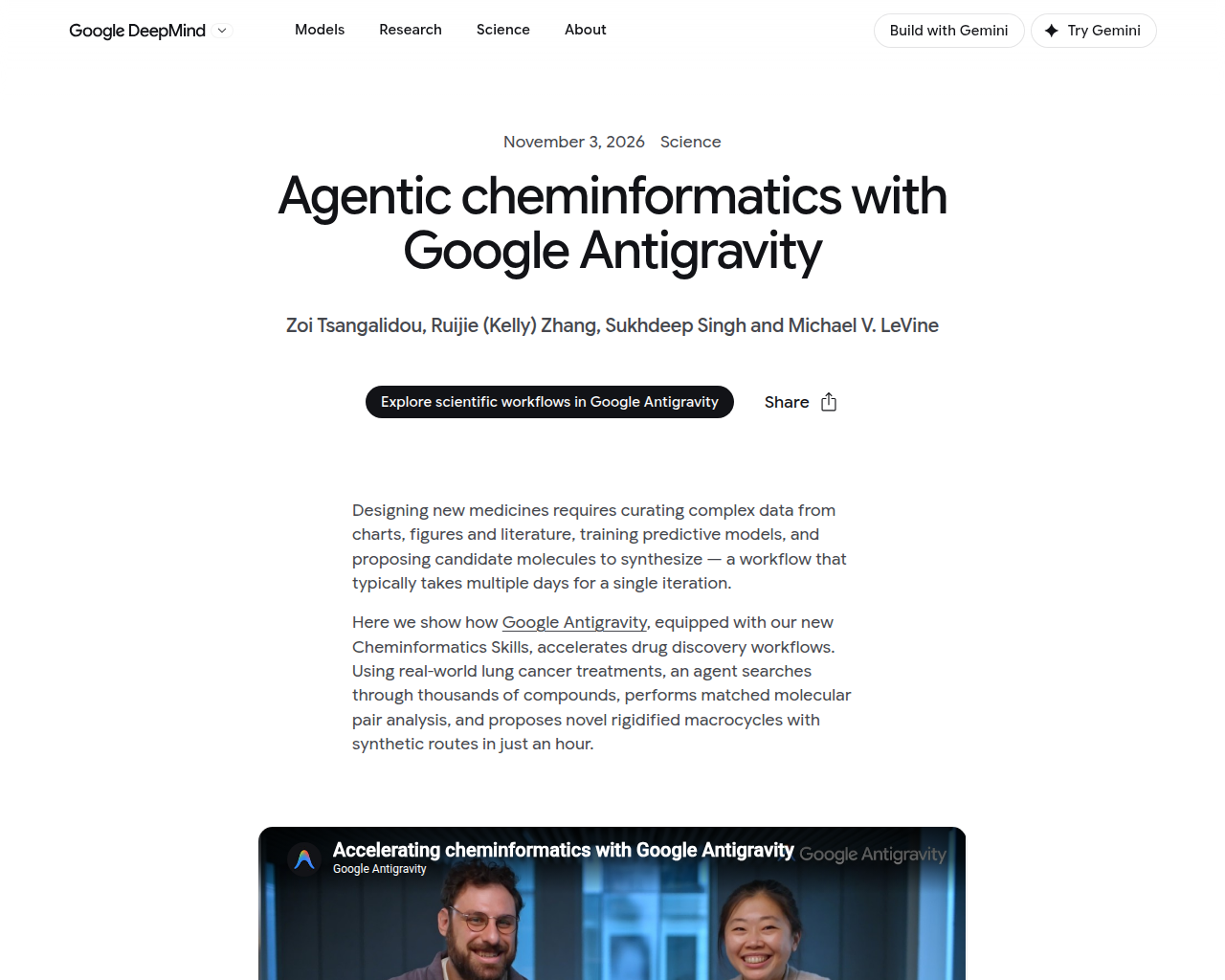
Google DeepMind published Agentic cheminformatics with Google Antigravity on November 3, 2026. It shows Antigravity, Google's agentic development platform, running a new set of Cheminformatics Skills through a medicinal chemistry workflow: searching the literature, curating compounds, running matched molecular pair analysis, training potency models, and proposing new rigidified macrocycles with synthetic routes. DeepMind says the work takes about an hour, against several days for one manual iteration.
This is not a new model or a benchmark result. It is an applied showcase. It still deserves a close read, because the way the system is built is the part that carries over to other work.
What shipped
The new piece is a suite of Cheminformatics Skills for Antigravity, and they split the work cleanly. Per the post, the language model handles "workflow orchestration, database navigation and scientific reasoning, while deterministic chemistry tools execute molecular calculations." The deterministic side is built on RDKit, with connectors to ChEMBL and PubChem. The skills also carry domain best practice: they tell the agent to prefer chronological train/test splits when compound dates exist, falling back to scaffold splits, for a more honest estimate of out-of-distribution performance.

The worked example
The case study uses a well-known medicinal chemistry story. Crizotinib, a first-generation tyrosine kinase inhibitor for non-small cell lung cancer, has five major rotatable bonds. Lorlatinib, a third-generation inhibitor, resembles it but is cyclized into a macrocycle, which brings the effective rotatable-bond count to zero and raises potency. The physics is the entropic penalty of binding: a floppy molecule loses conformational freedom when it locks into its active pose, so if you rigidify it ahead of time you "pay the entropic cost in advance."
What the agent does, as DeepMind describes it:
- Retrieval and curation. It pulls thousands of compounds from the literature, filters out noise such as buffers and solvents, records provenance, and notes that the macrocycles are mostly predicted to be brain-penetrant — which matters because this cancer often metastasizes to the brain.
- Exploration. It opens an interactive viewer; plotting potency against rotatable bonds, colored by macrocycle status, shows the most rigid compounds are the most potent.
- Matched molecular pair analysis. It compares molecules that differ only in cyclization; per the post, the agent suggested this analysis on its own.
- Modeling. It benchmarks several architectures and feature sets across four experimental readouts, using a scaffold split, and returns diagnostics for the scientist to review.
- Design. It proposes new macrocycles with reaction routes and curved-arrow mechanism diagrams, and can prepare candidates for AlphaFold or molecular dynamics.
Why the split matters
The DeepMind post states the constraint directly: in chemistry, "alter a single atom or bond and you have described a different compound altogether." A language model that writes SMILES strings from memory will sometimes describe a molecule that does not exist. The design here keeps the model away from the arithmetic of molecules: it decides what to compute and why, RDKit computes it, and curated resources supply the reference data.
Architecturally, this is the right division of labor for agentic systems well beyond chemistry. The model plans and explains; deterministic tools hold the invariants; domain rules, such as which split to use or which filters to apply, live in versioned skill definitions rather than the model's general knowledge. That last part is what I would watch most. A skill that encodes "use a chronological split when dates exist" is reviewable, testable methodology. Leave it to the model and you get a different habit on every run.
What I would want to see next
As a demonstration, this is persuasive. As evidence, it is thin. The example is a retrospective rediscovery of something chemists already know, since lorlatinib exists. That shows the plumbing works; it does not tell you whether the agent's new proposals are good. Three questions I would ask before relying on it:
- Extraction accuracy. How often are structures pulled from figures, IUPAC names and patents wrong, and how would anyone notice?
- Prospective validation. Do any proposed macrocycles get synthesized and tested, and how do they compare with what a medicinal chemist would have proposed in the same hour?
- Failure modes. What happens when the literature is sparse or contradictory? A curated dataset of thousands of compounds is the easy case.
None of that takes away from the post. It is an honest picture of what a well-built agentic workbench looks like for a field where precision is not optional: the model reasons, the tools compute, and the scientist reviews each step.