Your steering vector works. Does it mean what you think it means?
A new EMNLP 2026 paper tests whether LLM activation-steering vectors actually encode the geometric structure of human values, or just find shortcuts that move behavior without meaning anything coherent — and the answer splits steering methods into two camps.
The question nobody was asking
Activation steering has become the cheap alternative to fine-tuning: find a direction in a model's residual stream, add it at inference time, and you shift behavior toward or away from some trait — honesty, sycophancy, a particular value — without touching a single weight. It's fast, it's reversible, and a growing stack of alignment tooling leans on it.
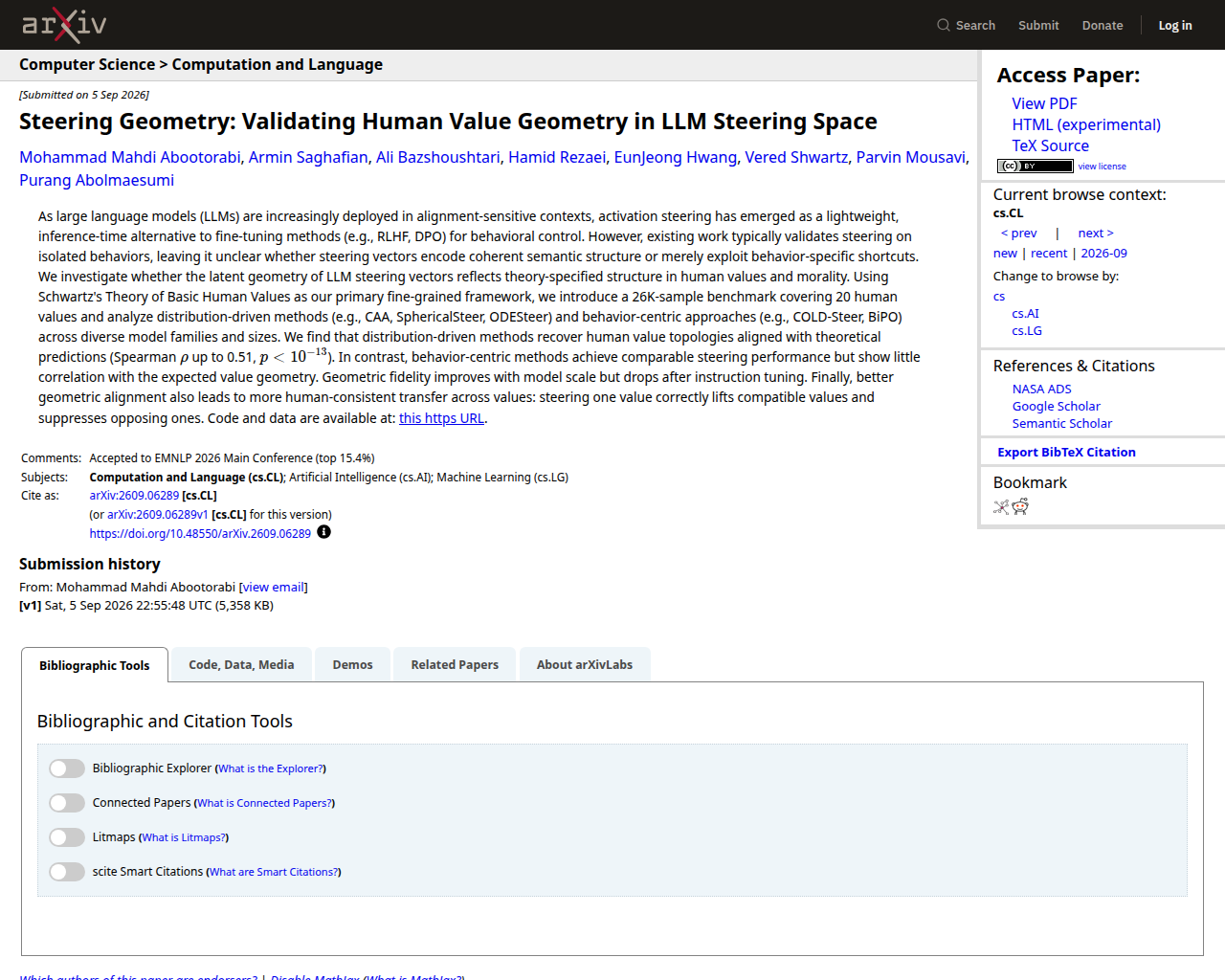
Most of that work validates a steering vector the same way: does pushing along it change the target behavior? If yes, ship it. What nobody checks is whether the vector encodes anything coherent about the concept it's supposed to represent, or whether it's a shortcut that happens to correlate with the right outputs on the eval set. A new paper, Steering Geometry: Validating Human Value Geometry in LLM Steering Space (accepted to EMNLP 2026 Main, top 15.4%), goes after exactly that gap — and the answer has direct consequences for anyone building steering into a real alignment pipeline.
Borrowing a ruler from psychology
To test "coherent structure" you need an independent ground truth for what the structure should look like. The authors borrow one from psychology: Schwartz's Theory of Basic Human Values, a well-validated model that arranges values like power, achievement, hedonism, self-direction, universalism, benevolence, conformity, and security around a circle. The circular arrangement isn't decorative — adjacent values (achievement and hedonism) tend to co-occur in people, while opposite values (power and universalism) trade off against each other. It's a theory with real predictive structure, not just a list of labels.
That gives the authors a benchmark: build a 26K-sample dataset spanning 20 human values, extract a steering vector for each value from a given method, and check whether the pairwise relationships between those vectors reproduce the circle — do adjacent-value vectors point in similar directions, and do opposite-value vectors point in dissimilar or opposing directions? They ran this across multiple model families and sizes, comparing distribution-driven steering methods (CAA, SphericalSteer, ODESteer) against behavior-centric methods (COLD-Steer, BiPO).

Same behavior, different geometry
The headline result is a clean split. Distribution-driven methods — which build a steering vector from the difference between distributions of positive and negative examples — recover value topologies that align with Schwartz's theoretical predictions, with Spearman correlation up to 0.51 (p < 10⁻¹³). That's a real, statistically strong recovery of structure the methods were never explicitly trained to reproduce.
Behavior-centric methods — which optimize the vector directly against a behavioral objective, as COLD-Steer and BiPO do — achieve comparable steering performance. If you only measured "did the output shift the way I wanted," you'd rate both families as equally successful. But their vector geometry shows little correlation with the expected value structure. They steer; they just don't seem to know what they're steering along in any structured sense.
That distinction matters because behavioral success is the only thing most steering papers report. This result says behavioral success is necessary but not sufficient evidence that a steering vector is doing something semantically grounded — two methods can hit the same benchmark number for entirely different reasons, one of which generalizes and one of which is closer to a shortcut.
Scale helps, instruction tuning hurts
Two secondary findings are worth flagging for anyone choosing a base model for steering work. Geometric fidelity — how well the recovered structure matches theory — improves with model scale, which fits the broader pattern of larger models encoding more linearly-decomposable, semantically organized representations. But fidelity drops after instruction tuning. That's a less comfortable finding: the same post-training that makes a model more usable and more aligned in the RLHF/DPO sense appears to reshape its representation space in ways that make theory-consistent value geometry harder to recover. If you're steering an instruction-tuned model expecting base-model-like structure, you may be steering a noisier substrate than you think.
Why geometry predicts transfer
The paper's most practically useful finding ties geometry back to something builders actually care about: cross-value transfer. When a method's steering vectors have better geometric alignment with the Schwartz structure, steering one value produces more human-consistent side effects on other values — it lifts compatible values and suppresses opposing ones, mirroring how these traits interact in people. Poor geometric alignment means steering one value has unpredictable, or theoretically incoherent, effects on adjacent ones.
That's the part I'd take into a design review. If you're steering a single, isolated behavior with no expectation of composing it with anything else, behavior-centric optimization might be fine — it hits the target, full stop. But if you're building a system where you need to steer multiple values together, or expect steering effects to interact the way human values do (suppress cruelty without also suppressing benevolence, say), you want a method whose vectors have demonstrated theory-consistent geometry, because that geometry is what's predicting sane composition and transfer.
The general lesson
Strip away the specific benchmark and the finding generalizes past values and morality: a steering method's benchmark score doesn't tell you whether its internal representation is structured the way you assume, and two methods with identical behavioral metrics can differ enormously in whether they'll compose, generalize, or transfer once you leave the narrow slice of behavior you validated on. If you're building steering-based alignment tooling, it's worth asking not just "does this vector move the behavior" but "does this vector's relationship to other vectors look like anything a theory would predict." The second question is harder to check, but per this paper, it's the one that tells you whether the tool will hold up outside the demo.