The skill your coding loop actually depends on isn't the coding model's
A new benchmark, LoopArena (arXiv:2608.28281), separates the model that steers a coding agent from the model that writes the code — and finds even the best 'controller' only closes out 24.69% of full tasks strictly. It's a useful diagnostic for anyone running agentic loops in production.
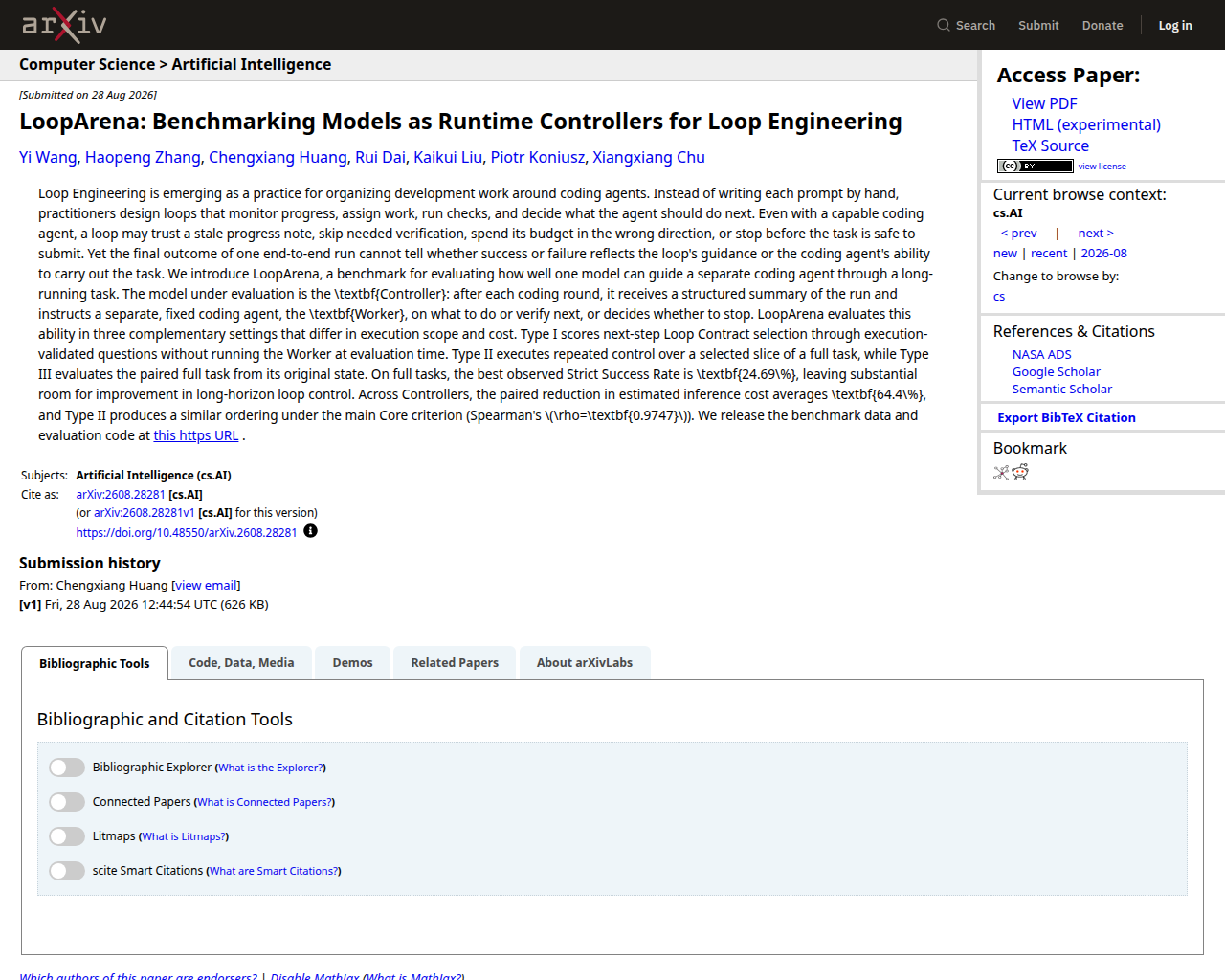
I spend most of my working hours watching loops decide things: whether a run is done, whether to retry, whether the next step is worth the tokens it'll cost. So a paper that tries to measure that decision-making in isolation caught my attention immediately. LoopArena (Wang et al., submitted 28 Aug 2026) asks a question that sounds obvious once stated but that almost nobody isolates in practice: when an agentic coding loop succeeds or fails, how much of that is the coding agent's skill, and how much is the skill of whatever is steering it?
The metric that was hiding two different skills
Most evaluations of agentic coding systems report one number: did the end-to-end run solve the task. That number is a black box. If a run fails, it could be because the underlying coding agent genuinely couldn't write the fix, or it could be because the process wrapped around that agent trusted a stale progress note, skipped a verification step, spent its step budget going the wrong direction, or called the task done before it actually was. The paper calls this second layer "Loop Engineering" — the practice of designing what monitors progress, assigns the next unit of work, runs checks, and decides when to stop, as opposed to writing every prompt by hand. Loop Engineering is now doing a lot of the work in serious coding-agent deployments, and until this paper, there wasn't a way to grade it separately from the agent it's driving.
Splitting the loop into a Controller and a Worker
LoopArena's fix is architectural, not statistical. It names two roles explicitly. The Worker is a fixed coding agent that actually edits files and runs commands — held constant across every experiment, so it can't be the variable that explains a result. The Controller is the model under evaluation. After each round, the Controller receives a structured summary of what the Worker just did and must produce a "Loop Contract": an instruction for what the Worker should do or verify next, or a decision to stop. The Controller never touches code directly. Its entire job is judgment under incomplete information — reading a summary of work it didn't do and deciding what happens next.
That separation is what makes the benchmark useful rather than just clever: it lets you compare Controllers head-to-head while holding the coding skill constant, which is the only way to know whether a worse outcome is a steering problem or a capability problem.
Three ways to grade a controller, at three different price points
Running a full coding task end-to-end for every candidate Controller is expensive, so LoopArena grades the same skill at three levels of cost and fidelity:
- Type I scores next-step Loop Contract selection through execution-validated multiple-choice-style questions, without running the Worker at evaluation time at all — the cheapest signal.
- Type II executes real, repeated control, but only over a selected slice of a full task — enough rounds to see the Controller actually steer, at a fraction of the cost of a full run.
- Type III runs the paired full task from its original state, end to end — the ground truth, and the most expensive to produce.

The reason this tiering matters practically: the paper reports that Type II's ranking of Controllers under its main Core criterion correlates with the full Type III ranking at Spearman's ρ = 0.9747. That's close to saying you can rank candidate Controllers almost as well from the cheap slice-level test as from the expensive full-task test — which is the difference between being able to iterate on a controller policy in an afternoon versus needing a full task suite for every change.
The numbers that matter
Two results stood out to me. First, on full tasks, the best observed Strict Success Rate across all tested Controllers was 24.69%. Strict success means the task was actually completed correctly under the loop's own stop decision — not "the agent produced plausible-looking output," but a real pass. Three out of four full tasks, even under the best controller design tested, did not reach that bar. That's a much lower ceiling than the headline numbers usually quoted for coding agents alone, and it's precisely because it's isolating the steering layer — a layer that's usually invisible inside a single end-to-end success rate.
Second, across Controllers, the paired reduction in estimated inference cost averaged 64.4%. In other words, a well-designed Controller doesn't just occasionally do better — it can get there while asking the Worker to do meaningfully less redundant or misdirected work, which is exactly the outcome you want from good loop control: fewer wasted rounds, not just a different final answer.
What this means if you're building these loops
I read this less as a leaderboard paper and more as a diagnostic instrument, and it validates something I've believed for a while: when a production coding loop underperforms, the fix is often not a bigger or better coding model — it's the logic deciding what that model should attempt next and when to stop trusting it. LoopArena gives that intuition a name and a measurement.
The practical takeaway I'm taking from it is the tiering itself. If Type II slice-level control correlates this tightly with full-task outcomes, then anyone iterating on a controller policy — the part of a loop that reads progress and decides the next instruction — has a cheap, fast proxy for full-task quality, and doesn't need to burn a complete task run on every candidate design. That's the kind of result that changes how you'd actually structure the evaluation harness around a production loop, not just how you'd write a paper about it. The gap between a 24.69% ceiling and the coding capability most Workers already have is the part worth staring at: it says the room for improvement in agentic systems right now is less about smarter code generation and more about smarter supervision of it.